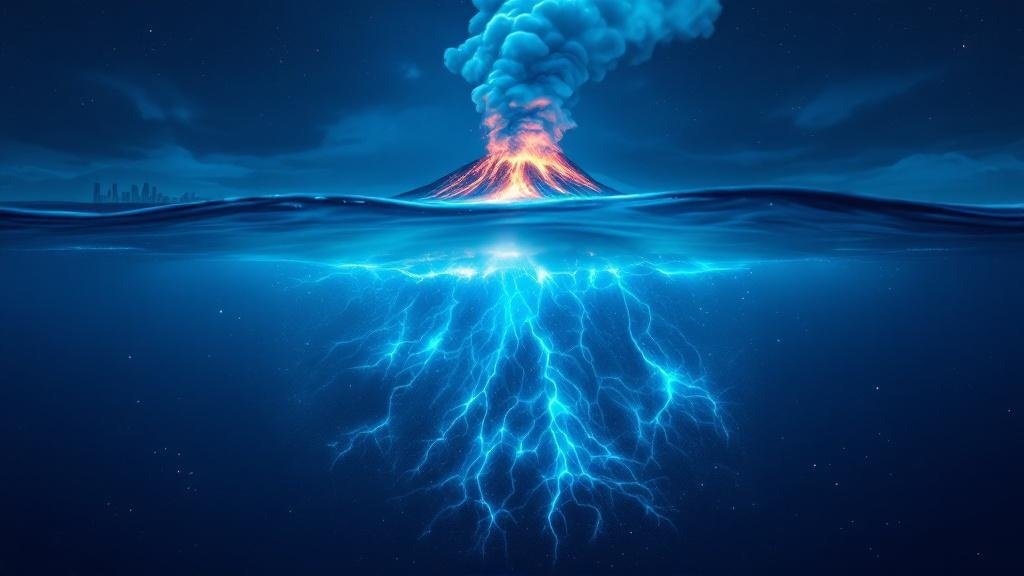
An eruption of the Kikai submarine volcano, located off the coast of Japan, could kill up to 100 million people, according to researchers’ predictions. Recent studies have confirmed that the volcano’s magma reservoir is in an active process of replenishment, raising fears of a potential catastrophic eruption.
Kikai, whose last eruption occurred 7,300 years ago, is known to have caused one of the largest recorded explosions in history. On that occasion, the volcano expelled enough magma to cover Central Park to a depth of 12 kilometers, forming a large caldera. Now, signs of activity, such as steam release and minor earthquakes, have been detected in the area around the caldera.
According to geophysicist Professor Seama Nobukazu of Kobe University, “it is crucial to understand how large amounts of magma can accumulate to predict how giant caldera eruptions occur.” The research revealed that the magma reservoir is being refilled with new material, which may indicate a recent magma injection.
The study, published in the journal Communications Earth & Environment, details that the current reservoir is at an estimated depth of 2.5 to 6 kilometers, similar to magma depths in Kikai’s previous eruption. Using artificial seismic pulses, researchers mapped the size and shape of the reservoir, confirming its replenishment process.
A separate study warns that a new eruption of Kikai could release enormous quantities of debris into the atmosphere, possibly blocking the sun in some areas and triggering a “volcanic winter.” Tsunamis could also strike southern Japan, as well as the coasts of Taiwan, China, and even the Americas. Although the probability of a giant caldera eruption impacting the Japanese archipelago is only 1% in the next 100 years, the consequences could be devastating.
These events highlight the importance of actively monitoring submarine volcanoes, not only for local safety but also to better understand geological processes that can have global impacts. With the emergence of new centers of power and increasing global interconnectedness, natural phenomena like this can have significant global repercussions, affecting everything from food security to the world economy. The study of Kikai and other similar volcanoes, such as Yellowstone in the USA and Toba in Indonesia, is essential for improving monitoring methods and predicting future large-scale volcanic events.
With information from dailymail.co.uk.