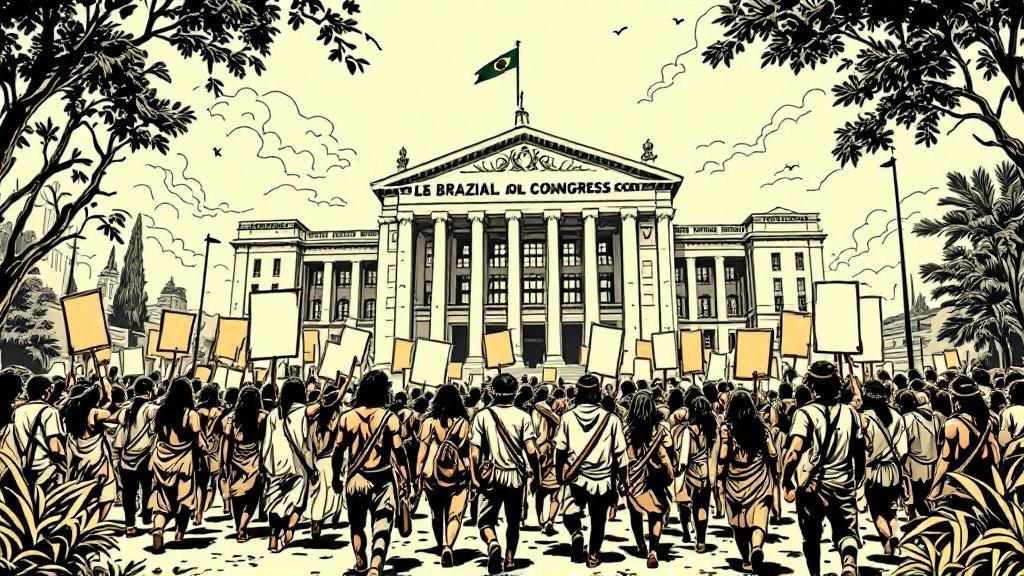
Approximately 5,000 indigenous people from over 200 ethnic groups marched through the Esplanade of Ministries in Brasília on Tuesday, marking the largest mobilization of indigenous peoples in Brazil. The demonstration is part of the 22nd edition of the Free Land Camp (ATL 2026), bringing together representatives from groups such as the Tikuna, Makuxí, and Guajajara. The group covered about 6 kilometers to reach the National Congress, identified by leaders as the main opponent to indigenous constitutional rights.
The march, described as peaceful and resistant, demands an end to legislative proposals that allow economic exploitation of traditional lands through mining and large enterprises. The central focus of the criticism is the Time Frame thesis, which limits land rights to areas occupied in October 1988. Although the Supreme Federal Court (STF) declared the thesis unconstitutional in 2023, the Senate approved a Constitutional Amendment Proposal (PEC) in 2025 that attempts to reinstate this limit. Currently, the text awaits further analysis by the Chamber of Deputies.
Protesters claim that the measure is a “coup” against the existence of communities and a direct obstacle to environmental preservation, essential for the country’s future and combating the climate crisis. Besides the legislative agenda, the movement pressures the federal government for speed in the homologation of new territories. Data from the National Foundation of Indigenous Peoples (Funai) indicates that between 2023 and the end of 2025, 20 new territories were validated, totaling 2.5 million hectares protected.
However, leaders like Dinamam Tuxá, coordinator of Apib, emphasize that there remains a backlog of about 110 claimed areas under review. The movement argues that delays in demarcations exacerbate scenarios of vulnerability and physical violence against indigenous leaders in various regions of Brazil. The mobilization also reinforces the strategy of “indigenizing politics,” encouraging the presence of indigenous representatives in public offices and decision-making spheres.
During the event, authorities such as Joenia Wapichana highlighted that strengthening bodies like Funai and the Special Secretariat of Indigenous Health (Sesai) depends on direct budget allocation and representation. With Brasília painted with urucum and jenipapo, the indigenous peoples reaffirm that they will not accept the sale of their territories and that demarcation is the only guaranteed way to ensure the survival of future generations.
For Apib, territorial protection is also climate protection: indigenous territories account for about 80% of the preserved biodiversity in the Amazon, according to the Socio-Environmental Institute (ISA). Therefore, popular pressure can be a catalyst for significant changes in national policy, ensuring the protection of indigenous rights and the environment.
With information from newsrondonia.com.br.
Original published at O Cafezinho.