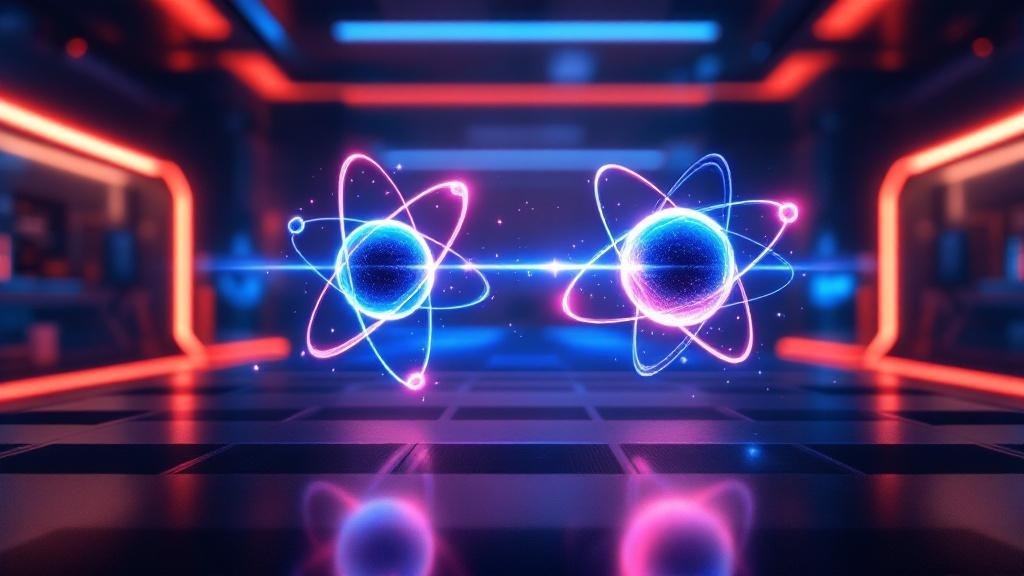
Quantum physics, with its shroud of mystery and limitless potential, has just taken a monumental step forward. For the first time, scientists have managed to capture atoms in two places simultaneously, a feat that challenges human understanding of reality and could revolutionize technology as we know it.
This discovery marks a significant advancement in quantum mechanics, which has long operated under two distinct theoretical frameworks. The recent experiment revealed a new facet of atomic behavior, confirming that atoms can indeed exist in multiple states or locations at once, an idea that previously seemed to be merely a theoretical abstraction.
This phenomenon, known as superposition, is the cornerstone of emerging technologies such as quantum computing, which promises to solve complex problems at speeds unimaginable for classical computers. The simultaneous capture of atoms in two distinct places not only validates quantum theories but also opens doors to technological and scientific innovations that could transform entire sectors, from medicine to digital security.
The research was conducted by an international team of physicists, who used a combination of light traps and laser cooling techniques to isolate and manipulate individual atoms. This method allowed scientists to observe the phenomenon of superposition on an unprecedented scale, providing new evidence for one of the most intriguing concepts in modern physics.
The results of this study not only reinforce the validity of quantum theory but also have significant practical implications. The ability to control and observe atoms in superposition could lead to the development of more powerful and efficient quantum computers. These devices have the potential to perform calculations that would be impossible for traditional computers, impacting areas such as cryptography, weather forecasting, and molecular modeling.
Furthermore, the research could influence the development of new medical imaging techniques and ultra-secure communication systems. Quantum superposition could enable the creation of high-resolution images at the atomic level, providing advances in understanding complex diseases and developing new treatments. In the realm of communication, systems based on quantum principles could offer unprecedented security, making data transmissions virtually unbreakable.
The impact of this discovery also extends to the field of philosophy, raising questions about the nature of reality and the role of observation in determining the state of a system. Quantum mechanics challenges common intuition, suggesting that reality may not be as solid and deterministic as it seems. This concept has fascinated philosophers and scientists for decades, and the recent research offers new opportunities to explore these profound questions.
Despite its promises, the practical application of quantum superposition still faces significant challenges. Maintaining atoms in superposition for prolonged periods and under controlled conditions is a complex task, requiring extremely precise and stable environments. However, continuous advances in technology and theoretical understanding suggest that these obstacles may be overcome in the near future.
The field of quantum physics is constantly evolving, and each discovery broadens the horizon of what is possible. As scientists continue to unravel the mysteries of the quantum world, it is likely that new applications and technologies will emerge that are still beyond imagination today. Capturing atoms in two places at once is just the beginning of a new era of scientific exploration, promising to redefine our understanding of the universe and humanity’s place within it.
Original published at O Cafezinho.