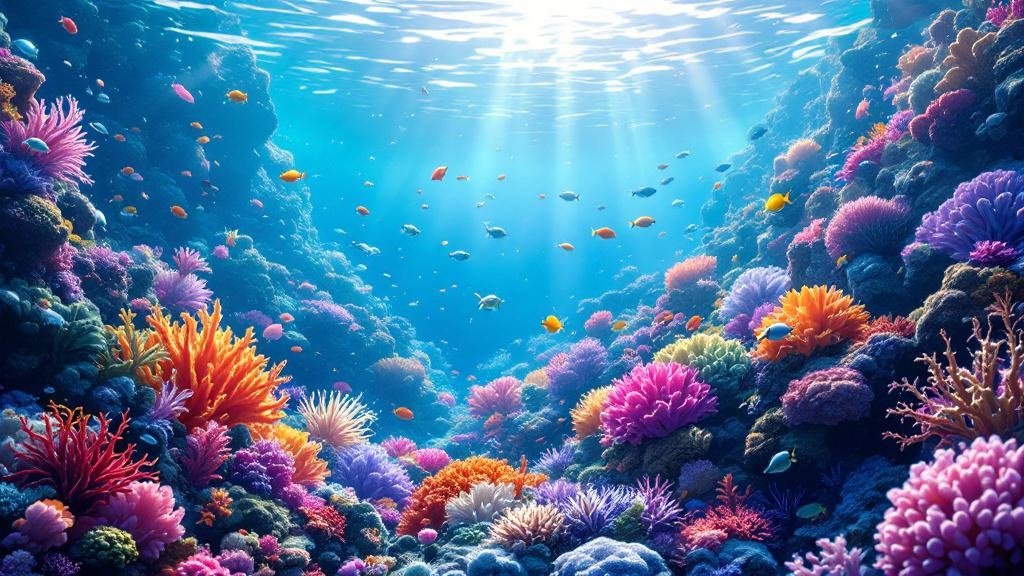
An underwater canyon as large as South Africa and over 3,500 meters deep off the coast of Argentina harbors one of the largest deep-water coral reefs ever discovered. Researchers, aware of its existence for over a century, finally captured stunning images of the site in 2025 during expeditions conducted by the Schmidt Ocean Institute.
During the summer, marine biologist Santiago Herrera from Lehigh University described the environment as “so lush that you lose perspective of where you are.” The live broadcast of the images, streamed on platforms like YouTube and Twitch, went viral in Argentina, reaching over 92,000 viewers at its peak. The success was such that the broadcast won the Martín Fierro Award, an Argentine distinction similar to the Emmy, for best video broadcast.
Scientists are determined to protect this newly revealed ecosystem. Using DNA collected during the expeditions, they aim to better categorize deep-water species. Additionally, taxonomists on board listed at least 40 unidentified animals, which may be new species. To safeguard the ecosystem’s health, artificial corals made of concrete and aragonite, structures that mimic coral skeletons, have been created.
Erik Cordes, an ecologist from Temple University, explains that the idea is for live corals, small polyp-shaped organisms that grow in colonies, to populate these artificial structures. “We haven’t done this in deep waters yet, so we’re improvising, borrowing many ideas from shallow-water coral restoration,” Cordes states.
The researchers plan a future expedition to check the progress of the artificial corals placed off the Argentine coast. They hope to explore more of this vast reef system, whose full extent remains unknown. “We still have the chance to do conservation instead of restoration,” says Daniel Lauretta, the expedition’s chief scientist. “And that is crucial because it is much easier and simpler to protect than to restore, especially in deep waters.”
This discovery offers a rare opportunity to study a thriving and intact ecosystem, allowing for the implementation of conservation measures before adverse impacts affect it. Moreover, identifying new species can expand our understanding of marine biodiversity and guide more effective environmental protection policies.
With information from scientificamerican.com.
Original published at O Cafezinho.