







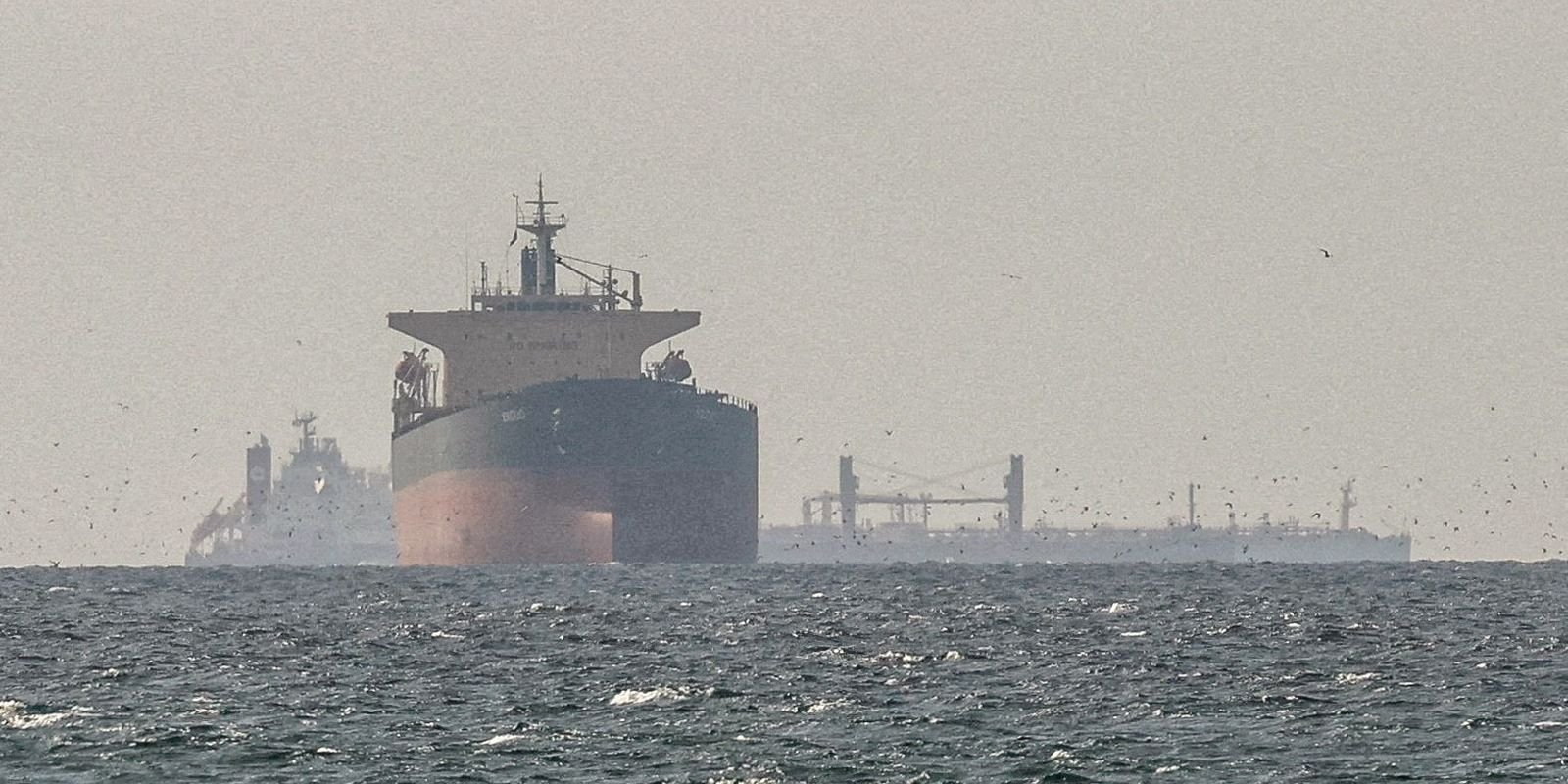
The United Arab Emirates (UAE) expressed concerns on Thursday (9th) that the passage through the Strait of Hormuz, a critical channel for 20% of the world’s oil and gas, remains under Iranian control. The UAE is calling for the passage to be completely free.
“The Strait of Hormuz is not open. Access is being restricted, conditioned, and controlled. A conditioned passage is not a passage. It is disguised control. This is not freedom of navigation,” lamented UAE’s Minister of Industry, Sultan Al Jaber.
According to him, 230 oil-laden ships are ready to set sail. “Every day the Strait remains restricted, the consequences worsen. Supply delays, markets tighten, prices rise,” added the head of the UAE’s state oil giant, Adnoc.
Upon announcing the ceasefire agreement with the United States (US), Iran stated that the passage would be subject to Iranian “coordination.”
“For a period of two weeks, safe passage through the Strait of Hormuz will be possible with coordination with the Iranian Armed Forces and considering technical limitations,” said a statement from Tehran’s Foreign Minister, Seyed Abbas Araghchi.
On Thursday (9th), Iran’s Revolutionary Guard shared a map with alternative navigation routes in the Strait of Hormuz due to the presence of several naval mines in the Strait.
Reuters reported that only one oil product tanker and five bulk carriers passed through the Strait of Hormuz in the last 24 hours, based on data from ship monitoring companies Kpler, Lloyd’s List Intelligence, and Signal Ocean.
An unidentified Iranian official told the Russian agency Tass that only 15 vessels per day would be allowed to pass during the two-week ceasefire, subject to Tehran’s approval and adherence to a protocol.
International pressure is mounting for Iran to fully open the Strait and not charge tolls for passing along the country’s coast. Tehran has argued that the status of Hormuz will never return to its previous state due to the aggression suffered by the country from the United States (US) and Israel.
The violation of the ceasefire by Israel through massive bombings in Lebanon has put the fragile agreement at risk, according to Iran. A meeting is scheduled for this Friday (10th) in Islamabad, Pakistan, between representatives of Tehran and Washington to discuss the conflict’s future.
Source: Agência Brasil.
Original published at O Cafezinho.