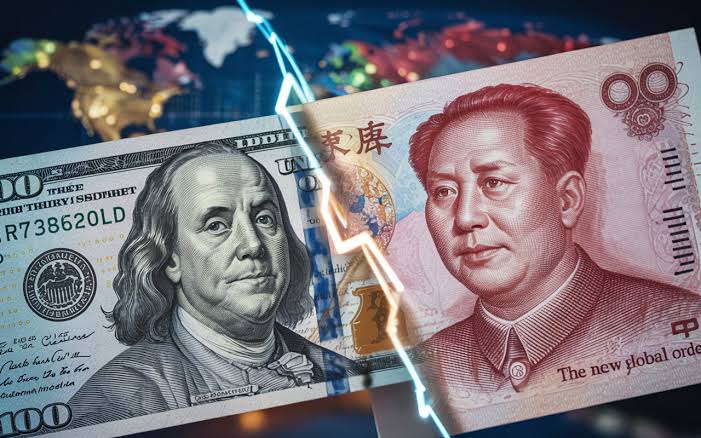
The yuan has reached a historic record in international payments. The conflict in the Middle East has emerged as a direct catalyst for this shift.
Recent data indicates that the Chinese International Payments System (CIPS) processed 1.22 trillion yuan in a single day. This amount is equivalent to approximately US$ 178.5 billion.
This volume is not an isolated incident. In March, the daily average had already surged to 920 billion yuan, representing an increase of nearly 50% compared to February.
This figure reveals a structural trend.
The yuan is beginning to gain significant traction as an international settlement currency, particularly in strategic sectors like energy.
According to analysts at Standard Chartered, the conflict involving Iran has served as a direct catalyst for this development.
The rationale is clear.
Amid elevated risk in the Middle East, nations and corporations are seeking alternatives to the traditional financial system, which is predominantly dollar-denominated.
This encompasses avoiding sanctions, reducing operational costs, and expediting transactions.
CIPS emerges in this scenario as an alternative infrastructure to SWIFT, a global system historically controlled by Western nations.
The key differentiator lies in its autonomy.
Yuan transactions conducted within CIPS do not rely on American banks nor traverse the U.S. financial system.
This mitigates exposure to potential blockades and sanctions.
Another significant factor is the relative stability of the Chinese currency.
Even amidst global turbulence, the yuan has maintained a more predictable trajectory, thereby enhancing its appeal in international contracts.
This growth also reflects China’s sustained investment.
Beijing has been actively expanding its payment network, integrating banks, corporations, and nations into its proprietary system.
This strategic shift was already underway.
However, the conflict has accelerated this process.
Crises often disrupt established paradigms.
And, in this instance, the paradigm in question is the dollar’s pervasive dominance in global trade.
On a geopolitical level, the impact is direct.
The expansion of the yuan diminishes the centrality of the United States within the international financial system.
This consequently alters the global balance of power.
Nations now possess more avenues for negotiation, particularly in critical sectors such as oil.
For Brazil, the implications are strategic.
The nation already maintains robust trade relations with China and stands to expand transactions in local currency, thereby reducing costs and mitigating exchange rate dependency.
Furthermore, Brazilian enterprises could integrate with CIPS to facilitate faster international operations.
However, a significant challenge remains.
Without adequate financial and technological integration, Brazil risks being marginalized from this nascent global financial architecture.
China’s actions reveal a consistent pattern.
Establishing proprietary infrastructure, achieving scale, and leveraging crises to expand influence.
The record of US$ 178 billion transcends mere numerical significance.
It is indicative of a profound shift within the global system.
And it signals that the contest for the future of global currency has unequivocally commenced.
With information from SCMP