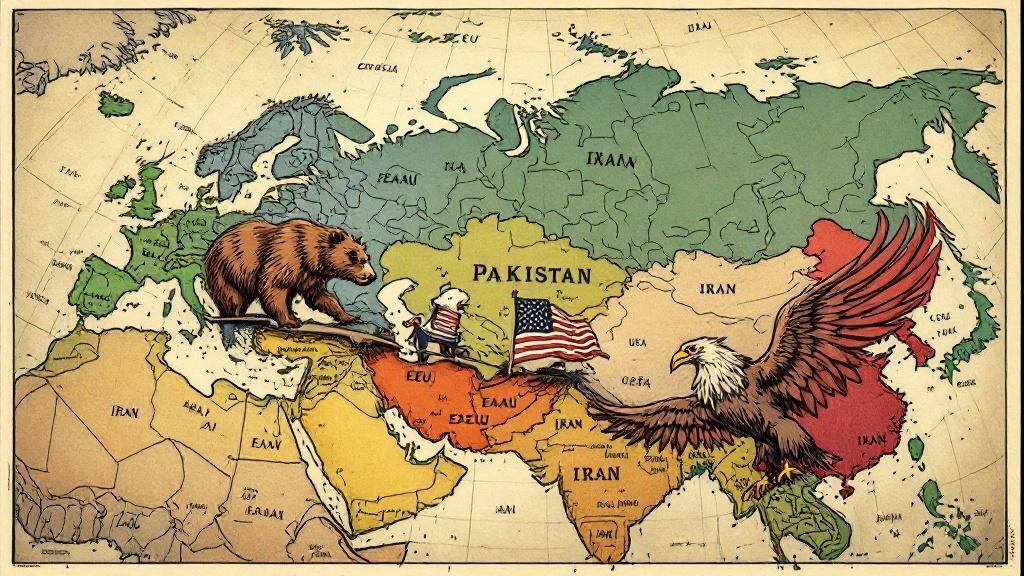
Pakistan is expanding its economic and strategic relations with the Eurasian Economic Union (EAEU), a bloc comprising Russia, Belarus, Kazakhstan, Armenia, and Kyrgyzstan, representing a market of 180 million people.
Countries like Iran, Cuba, and Uzbekistan hold observer status within this group.
On April 9, Andrey Slepnev, a member of the Trade Council of the Eurasian Economic Commission, met with Jam Kamal Khan, Pakistan’s Federal Minister of Commerce, in Islamabad to discuss strengthening trade ties and integration across various sectors.
According to Jam Kamal Khan, the partnership with the EAEU goes beyond trade and includes sectors such as logistics, energy, digital commerce, industry, and supply chains.
This cooperation has the potential to expand Pakistani agricultural exports, foster joint projects in science and technology, and open new avenues in the energy sector.
Nasir Abbas Shirazi, president of the Pakistan and Gulf Studies Center, highlighted that closer ties with the Eurasian bloc offer Pakistan the opportunity to build strong partnerships outside the predominant influence of Western economies, as well as create opportunities in research, education, and economic development.
With a growing demand for energy, Pakistan seeks to diversify its import sources, and the EAEU emerges as a strategic ally in this context.
The country’s geographical position also plays a crucial role, potentially connecting Central Asia to the Middle East and South Asia.
Free trade agreements with the EAEU could integrate the bloc’s markets with the routes of the China-Pakistan Economic Corridor (CPEC) and Pakistani port facilities, such as the Gwadar port, expanding the commercial reach of both parties.
Meanwhile, Pakistan is closely monitoring diplomatic negotiations between the United States and Iran, taking place in Islamabad.
These talks, centered on nuclear issues and regional tensions, have drawn international attention but do not divert Pakistan’s focus from its long-term economic agenda with Eurasia.
The country’s strategy demonstrates an effort to balance immediate international mediation interests with building a more diversified and independent economic base.
Pakistani exports, still concentrated in Western markets, could gain new momentum with the agreements under negotiation with the Russia-led bloc.
This dual approach by Pakistan reflects a pragmatic vision, aiming not only to play a significant role in global diplomacy but also to secure lasting economic benefits through partnerships with emerging blocs.
The relationship with the EAEU could redefine the country’s trade priorities, promoting greater regional connectivity and reducing dependence on traditional markets.
As US-Iran talks progress, Pakistan appears determined to consolidate its position as a convergence point between different spheres of geopolitical and economic influence.
For more information on the developments of this movement, check out the full analysis on the Sputnik portal.
Original published at O Cafezinho.