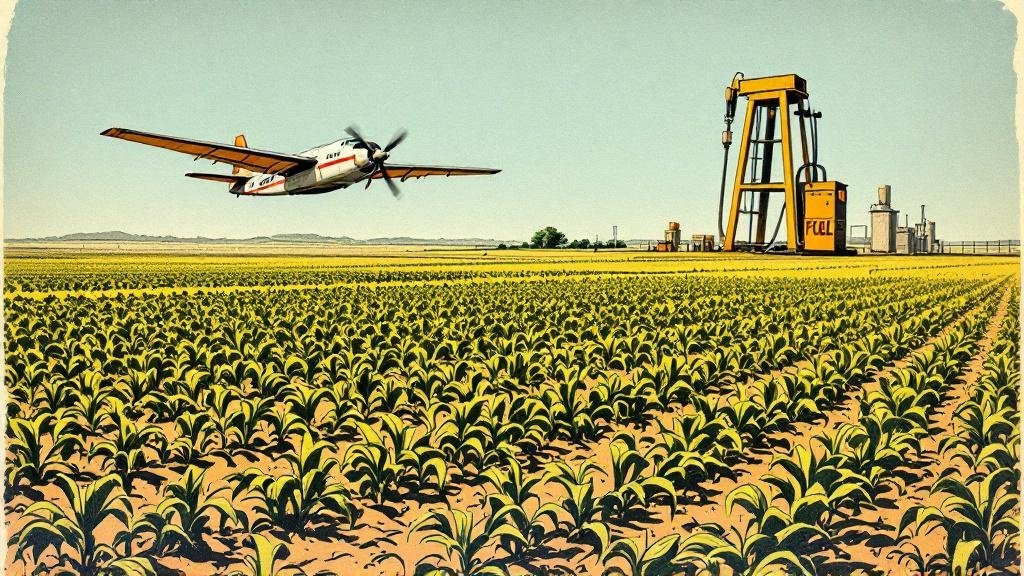
The National Union of Agricultural Aviation Companies (Sindag) has released a study indicating a significant increase in fuel prices used in agricultural aviation, exerting substantial pressure on the sector’s operational costs and threatening to raise food prices.
According to the survey, aviation gasoline (Avgas) saw a 67.3% increase, while aviation kerosene (QAV) rose by 51.6%. These figures reflect a significant impact on agribusiness, a crucial sector for the national economy, with direct effects on the production chain.
Titled “Fuel Inflation on Agricultural Aviation,” the study details that Avgas, used in piston-engine aircraft, was the most affected by the price surge. QAV, used in larger turboprop aircraft, also experienced a considerable increase.
Other energy inputs, such as ethanol and diesel, showed more contained variations, with increases of 6.9% and 7.7%, respectively. Based on these data, Sindag estimates that operational costs for agricultural aviation companies have risen between 14% and 40%, depending on the region and fleet type, with a national average of approximately 25%.
To maintain the economic sustainability of operations, the sector foresees the need for service price adjustments exceeding 10%. Cláudio Júnior Oliveira, Sindag’s operational director and the economist responsible for the research, emphasized that the increase in aerial application costs directly impacts the final prices of food, fibers, and energy.
The study analyzed data from thirty agricultural aviation companies across various regions of the country, covering strategic hubs of national agricultural production.
The impact becomes even more significant considering that the country’s top ten agricultural products accounted for over 40% of national exports in 2025, according to sector data. Agricultural production is concentrated in eight states, which also house 87% of the agricultural aviation fleet, amplifying the effects of these cost increases across the economy.
The Agricultural Aviation Inflation Index (Iavag) also reflects this pressure, recording an increase of over 6.75% at the beginning of 2026, driven mainly by energy costs, as highlighted by Sindag’s survey.
Oliveira noted that fuel is a determining factor for the competitiveness and operational capacity of companies in the sector. The current scenario, according to the entity, results from a combination of international dynamics, such as fluctuations in the oil market, and domestic factors that increase the sector’s vulnerability to external variations.
To address this situation, Sindag plans to forward the research results to the Institute for Agricultural Thought (IPA), the Parliamentary Agricultural Front (FPA), and federal government agencies, proposing measures such as subsidies to curb the rise in fuel prices.
Agricultural aviation companies have been seeking alternatives to mitigate costs, revising contracts, adjusting operations, and investing in efficiency. There is also a growing interest in more stable energy sources, such as ethanol, which showed less volatility during the analyzed period.
Despite these initiatives, the sector maintains a cautious outlook, warning of the risks of a broader economic impact if the upward trend persists, as reported by the official Sindag portal.
With information from aeromagazine.uol.com.br.
Original published at O Cafezinho.