
Brazil has two major inflation indices that are crucial for understanding the national economic dynamics. The best-known is the IPCA (Broad National Consumer Price Index), calculated by the IBGE, which measures retail inflation and reflects the cost of living for the final consumer. However, there is another fundamental indicator, the IGP-10 (General Price Index – 10), from the Fundação Getúlio Vargas (FGV), which tracks price variations in wholesale, consumer, and construction sectors.
Economists often observe the IGP-10 as a sort of preview of retail inflation, as wholesale price variations tend to be passed on, over time, to the final consumer, directly impacting prices in supermarkets and other establishments. The recent news about the latest IGP-10, released by the FGV, brought a particularly relevant piece of data: a sharp drop in wholesale prices in Brazil.
According to the FGV report, the IGP-10 registered a variation of 0.08% in October (monthly variation), after a 0.21% variation in September (monthly variation). The index, which shows a downward trend, has accumulated a drop of 0.98% in the year and a variation of 1.60% in the last 12 months. The component that contributed most to this deceleration was the IPA-10 (Broad Producer Price Index), which registered a drop in October (monthly variation).
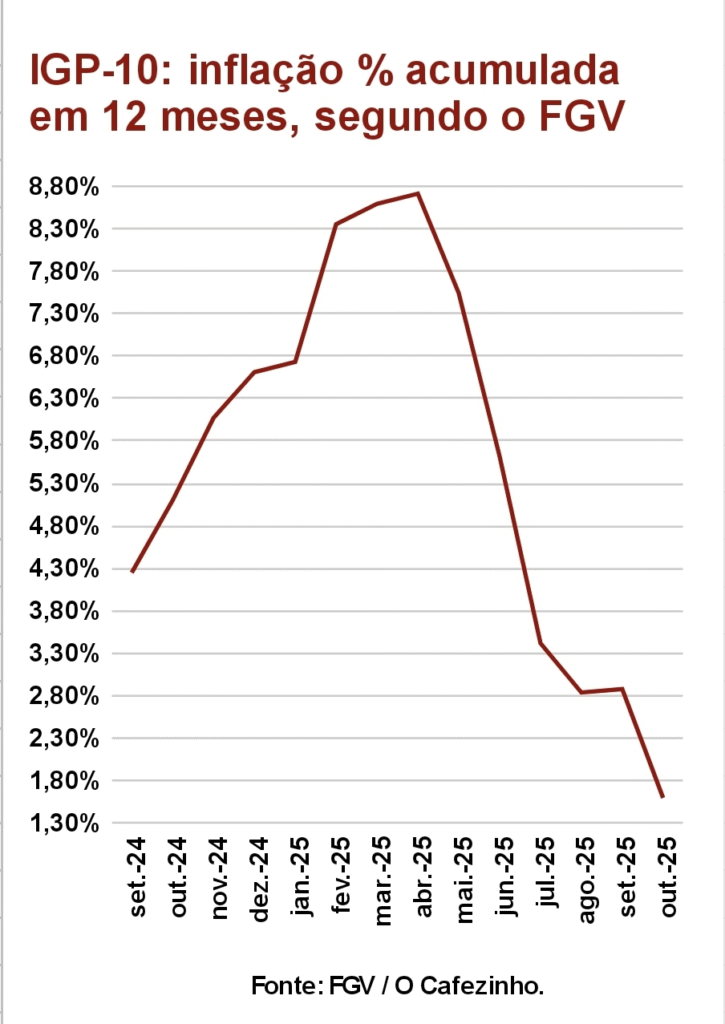
This news is especially positive for the country’s poorest families, and also for the government’s popularity. The sharp drop in the IPA, which reflects wholesale food prices, is a crucial factor. Products such as soybeans (in grain), cattle, and rice (in husk) registered significant drops in October. The 12-month accumulated IPA-10, which was at 6.08% in December 2022 and 7.31% in December 2024, now stands at 0.35% in October 2025, showing strong deceleration. Coffee (in grain), which at the peak of its accumulated consumer inflation (IPCA) reached 80.2% in 12 months (May 2025), now shows signs of slowing, with a monthly variation of 3.05% in October (IPA-10), after 22.37% the previous month, indicating its prices are also beginning to ease.
Besides food, the construction sector also showed signs of deceleration. The INCC (National Construction Cost Index) registered a variation in October (monthly variation), below the rate observed in September (monthly variation). The drop in construction material prices may facilitate more building projects and, consequently, generate more jobs in the sector.
These movements in price indices, especially the deceleration in wholesale, suggest an easing of inflationary pressures, which could translate into greater purchasing power for consumers and a more stable economic scenario. Monitoring these indicators is essential to understand the future trends of the Brazilian economy.
Regarding the IPCA, Brazil’s official inflation index, the good news extends here as well. Data released by the IBGE in October 2025 indicated that in September 2025, the IPCA registered 0.48% monthly, accumulating 5.17% over the last 12 months. Food inflation, a significant item in the family budget, has also shown signs of deceleration in the IPCA, reinforcing the positive outlook for the final consumer.
Notes for International Readers:
- FGV (Fundação Getúlio Vargas): A highly respected Brazilian higher education institution and independent think tank, considered one of Latin America’s leading sources for economic data, statistics, and analysis.
- IPCA (Índice Nacional de Preços ao Consumidor Amplo): This is Brazil’s official inflation index, similar to the Consumer Price Index (CPI) in the United States. It is calculated by the IBGE.
- IBGE (Instituto Brasileiro de Geografia e Estatística): The Brazilian Institute of Geography and Statistics, the main government agency for census data and national statistics, similar to the U.S. Census Bureau or Statistics Canada.
- IGP-10 (Índice Geral de Preços – 10): A General Price Index calculated by the FGV. It is a composite index that heavily weighs wholesale (producer) prices, making it a key indicator of future inflation that will eventually reach the consumer (IPCA).
- IPA-10 (Índice de Preços ao Produtor Amplo): The Broad Producer Price Index, the main component (60% weight) of the IGP-10, tracking factory-gate and farm-gate prices (wholesale).
- INCC (Índice Nacional de Custo da Construção): The National Construction Cost Index, also part of the IGP-10 (10% weight), tracking costs in the civil construction industry.