
It worked!
It must not be easy to be a Bolsonarista today. The supporters of Eduardo Bolsonaro and Paulo Figueiredo woke up to terrible news. After the two fools were practically kicked out of the State Department days ago, when they tried to sabotage the normalization of trade relations between Brazil and the United States, they will have to explain this defeat as well.
They spent the last few weeks promising their followers that Donald Trump would stage a “coup” by appointing Marco Rubio as interlocutor. No coup happened. Marco Rubio met amicably with Mauro Vieira, our Minister of Foreign Affairs. Then they said Trump would try to humiliate Lula in public. That didn’t happen either.
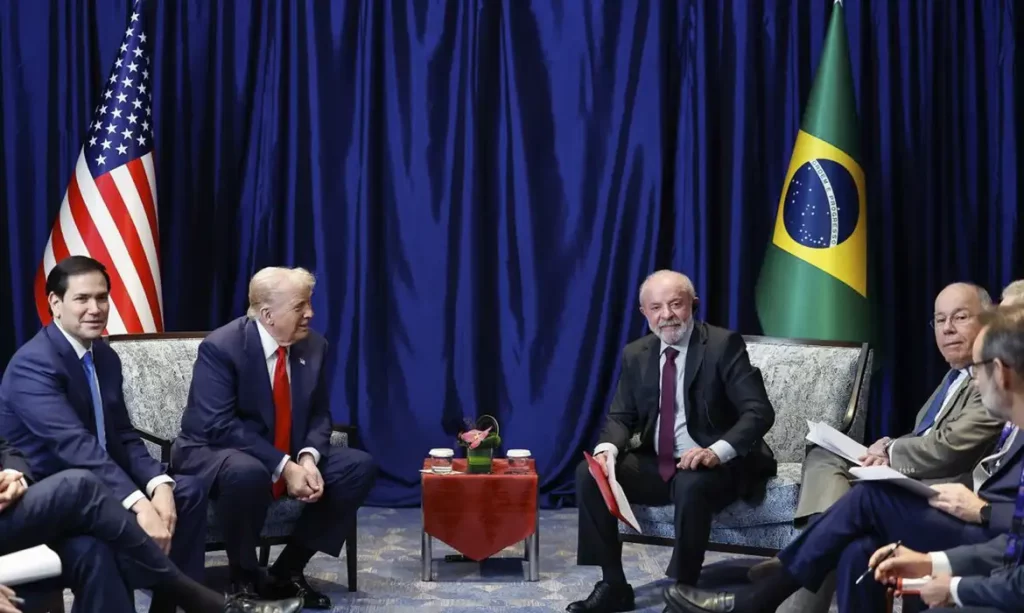
This Sunday, October 26, President Luiz Inácio Lula da Silva met with Donald Trump in Kuala Lumpur, Malaysia, during the 47th ASEAN summit. The meeting, which lasted approximately 50 minutes, was the first between the two since a brief conversation at the UN General Assembly in September. It occurred in the wake of the imposition of 50% tariffs on Brazilian products and sanctions on Brazilian authorities due to the trial of former president Jair Bolsonaro.
Alongside Lula were the Minister of Foreign Affairs Mauro Vieira and, on the American side, Secretary of State Marco Rubio. The meeting was marked by a friendly tone that disproved all the catastrophic predictions from Bolsonaristas about a possible humiliation or diplomatic “coup.”
During the meeting, the Brazilian president was direct. He stated that there is no reason for disagreements between Brazil and the United States and asked Trump for the immediate suspension of the tarifaço (massive tariff hike) while the two countries are in negotiations. “Brazil is interested in having an extraordinary relationship with the United States. There is no reason for there to be any disagreement, because when two presidents sit at a table, each one puts forward their point of view and the natural tendency is to move toward an agreement,” said Lula.
According to a member of the Brazilian delegation, the president also told Trump that the former president’s trial followed due process of law and that the sanctions on authorities of the STF (Supreme Federal Court) were unjust. Lula reiterated the desire for a stable and productive relationship between the two countries, making it clear that he had an extensive agenda to discuss.
The American president signaled openness to an agreement. He said it was an honor to be with the Brazilian leader and that they would probably make “some good agreements.” “We are going to discuss [tariffs] a bit. We know that we know each other. We know what each other wants,” Trump stated. When asked about Jair Bolsonaro, the American president said he “feels bad” for what the former president went through, but did not answer if the matter would be discussed.
More significant was Trump’s declaration of admiration for Lula’s political trajectory. According to Foreign Minister Mauro Vieira, Trump acknowledged that Lula “having already been president of the Republic twice, having been persecuted in Brazil, recovered, proved his innocence, ran again, and victoriously won the third term” — a compliment that completely refutes the Bolsonarist narrative of confrontation.
After the meeting, Foreign Minister Mauro Vieira confirmed its success. “The conversation was very positive, the final balance is great. President Trump declared that he will give instructions to his team to begin a bilateral negotiation process, which should start today, because everything is to be resolved in a short time,” noted Vieira. Trump authorized his team to begin negotiations for the revision of the tarifaço on Sunday night, local time in Malaysia.
The Brazilian government’s expectation is that, during the bilateral negotiation, the tariffs will be suspended. According to Vieira, “we hope in a short time to conclude an agreement that deals with each of the sectors of the current American taxation on Brazil.”
The Brazilian president also took the opportunity to propose himself as an interlocutor between the US and Venezuela, reaffirming Brazil’s tradition as an element of peace in the region. “President Lula said that South America is a region of peace and offered to be an interlocutor with Venezuela, to seek mutually acceptable solutions between the two countries,” said the foreign minister. “Brazil will always be willing to act as an element of peace and understanding, which has always been Brazil’s tradition,” he completed.
The two presidents agreed to reciprocal visits: Trump expressed a desire to come to Brazil, and Lula accepted going to the United States with pleasure. Trump also declared that he admires Brazil and immensely likes the Brazilian people.
We can say that the tarifaço was yet another nth political turn in which Bolsonarism tried to reverse the election results. It generated a resounding defeat for the Brazilian far-right.
President Lula’s strategy of not kneeling to the empire, of offering firm but peaceful resistance, without trade retaliation, but with harsh and fearless rhetorical protests, worked. The great diplomatic and extra-diplomatic mobilization, bringing together the top professionals from Itamaraty (Brazil’s Foreign Ministry) and major business leaders from Brazil and the United States, worked. The brilliant calculation of choosing terrain more favorable to Lula, without a live press conference to avoid traps, with the presidents seated at a reasonable distance, worked.
The president showed no fear. He maintained a direct and, at times, tough stance, in defense of what he considers to be the obligation of a Latin American head of state: to criticize the murder of boat crews without trial and transparency, to criticize the tarifaço, to defend national sovereignty. And he managed, through diplomatic intelligence, to transform a very complicated situation of confrontation into an opportunity for opening a bilateral understanding.
Tarcísio de Freitas, governor of São Paulo and Lula’s possible adversary in next year’s elections, as well as the entire Brazilian far-right, emerged defeated from this process. Tarcísio, in particular, revealed he lacks the moral fiber necessary to lead a country like Brazil. During the height of the tarifaço, he publicly suggested that Lula should humiliate himself before the international press in the Oval Office, offering a victory to Trump — as if the Brazilian president should pose as Zelensky. While Lula negotiated with intelligence and firmness, Tarcísio showed himself incapable of understanding that ceding to the empire is not pragmatism, it is just capitulation, and that would be disastrous for our economic and geopolitical interests.
Notes for International Readers:
- Bolsonarista: A supporter of former far-right president Jair Bolsonaro.
- Paulo Figueiredo: A right-wing Brazilian commentator based in the US, allied with the Bolsonarist movement.
- Mauro Vieira: Brazil’s Minister of Foreign Affairs (often referred to as chanceler).
- ASEAN: Association of Southeast Asian Nations.
- Tarifaço: A Brazilian-Portuguese slang term meaning a “massive tariff hike” or “tariff slam.”
- STF (Supremo Tribunal Federal): The Supreme Federal Court, Brazil’s highest court.
- Itamaraty: The common name for Brazil’s Ministry of Foreign Affairs, named after the palace that houses it.
- Tarcísio de Freitas: The governor of São Paulo, Brazil’s most populous and wealthiest state. He is a key figure on the Brazilian right and a potential future presidential candidate, seen as an heir to Bolsonaro.
- Zelensky: The reference to “posing as Zelensky” is used pejoratively by the author to imply a posture of subservience or begging for help from Western powers, which the author accuses Tarcísio of advocating for.