
Ai image
The Dragon Obliterates Trump’s Tariffs
While the United States has spent the last few decades squandering trillions of taxpayer dollars on endless wars, regime changes, and coups, China has been investing in high-speed trains, urban infrastructure, research centers, and universities.
The result of this difference in focus is visible today: China holds the world’s largest international reserves, with over $3.3 trillion, equivalent to 18% of its GDP. For comparison, U.S. reserves represent a mere 1.5% of its GDP—twelve times less than China.
China’s financial strength is even more evident in its ability to cover its foreign debt with international reserves: 65.5% in China, versus a meager 1.6% in the United States.
Faced with the imperial arrogance of the United States, China has asserted its will to live and trade. As the poet Li Bai (701-762) wrote: “I do not seek honors or riches / only that spring does not abandon me”.
Other impressive numbers are those of foreign trade, as they are transparent and verifiable—one country’s export figures must match the other’s import figures.
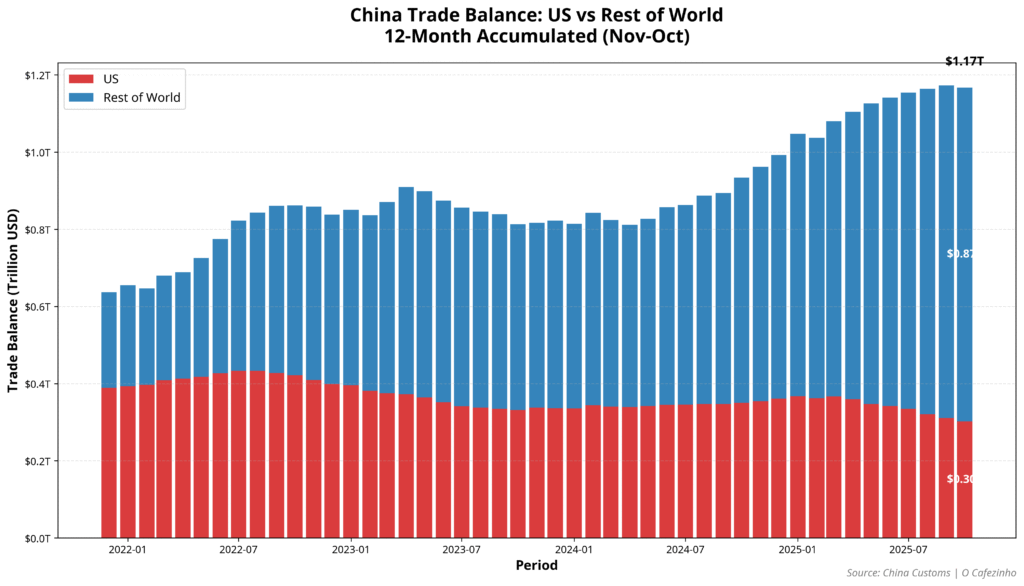
And here the contrast is stark: China reached a record trade surplus of $1.17 trillion in the 12 months leading up to October 2025.
Meanwhile, the United States is grappling with a deficit that had already reached $713.6 billion in the first eight months of the year alone.
The irony is that while China releases its October data, the U.S. is still on August, a reflection of the delay and loss of transparency from a country that was once the global standard for statistical transparency.
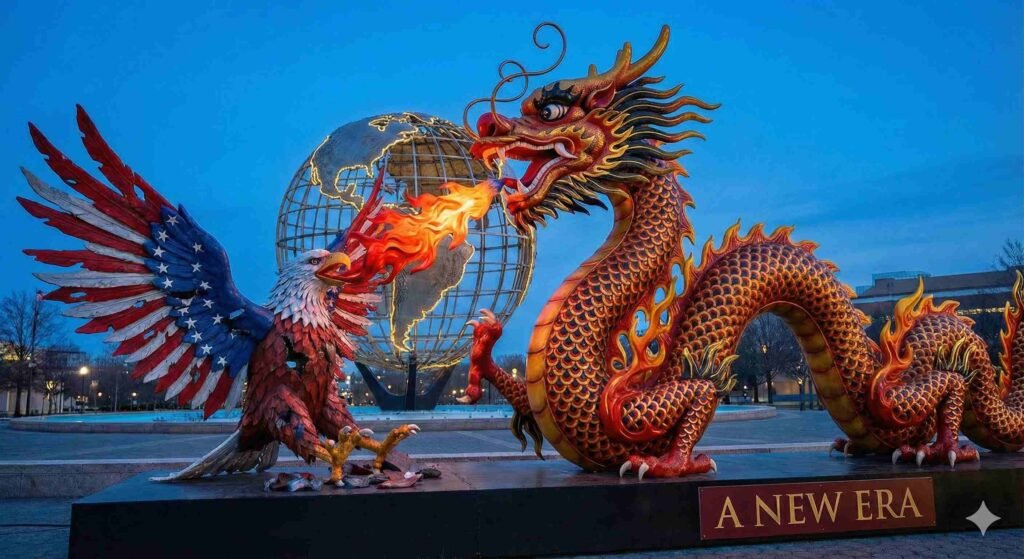
Donald Trump’s infamous attacks on international trade, which began with the so-called “Liberation Day” on April 2, 2025, when he announced a tariff on the entire world, brought the trade of goods into the spotlight.
The disastrous reaction of the U.S. financial markets themselves forced him to back down and try to frame the measure as a geopolitical move focused solely on China, which also failed.
China was heavily attacked, but the outcome was the opposite of what was expected: the country increased its trade volume even as it reduced its exchange with the United States.
It is a victory for the entire Global South, which crushes the tariffs and represents a major geopolitical defeat for the U.S. and the international far-right that has clung to Trump’s reputation, particularly in Latin America, such as Milei and Bolsonaro.
The declining relevance of the United States to China’s trade balance is remarkable. In 2022, trade with the U.S. accounted for almost half of China’s total surplus; today, that share has plummeted to just 26%.
In terms of volume, the bilateral trade flow between China and the U.S. plummeted by 24.5% in just one year: from $59.7 billion in October 2024 to $45.1 billion in October 2025.
The paradox is clear: Trump’s tariffs managed to reduce bilateral trade, but failed to affect China’s overall balance, which simply found new and more important trading partners.
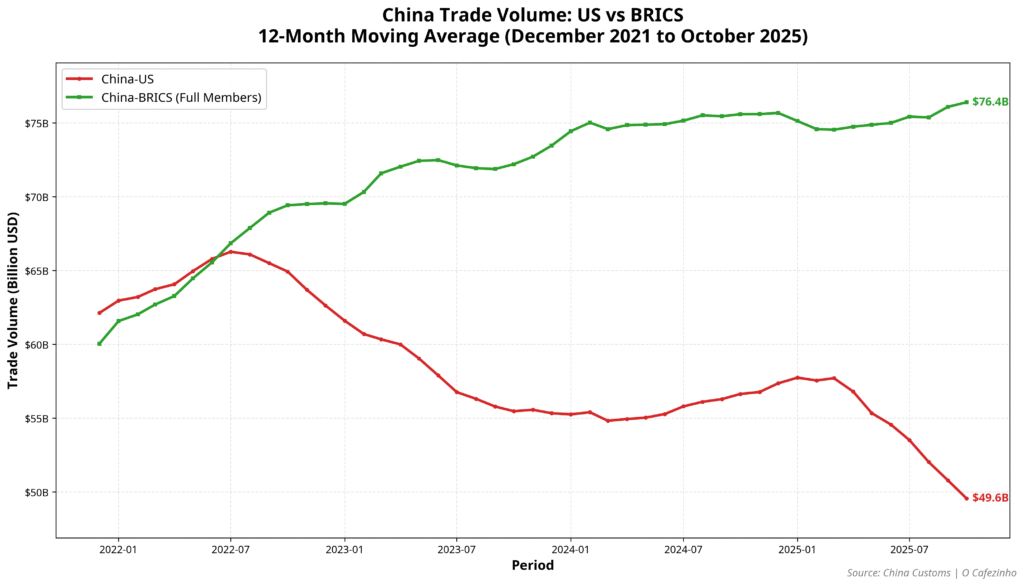
The main one was BRICS. In a historic reversal, China’s trade with the bloc’s full members (Brazil, Russia, India, South Africa, Iran, Egypt, United Arab Emirates, Ethiopia, and Indonesia) surpassed its trade with the U.S. in mid-2022.
The monthly 12-month moving average of trade between China and the full members of BRICS jumped from $60 billion in December 2021 to $76.4 billion in October 2025, a 27% increase.
The strengthening of South-South relations has proven to be a successful geographic diversification strategy.
Another strategic partner was ASEAN, which is approaching U.S. trade levels. The monthly 12-month moving average with the Southeast Asian bloc reached $86.5 billion in October 2025, up from $79.7 billion in the same month last year, an 8.5% increase.
Regional integration in Asia has deepened, consolidating China’s leadership in continental trade.
Two development models are in conflict. On one hand, China advances quietly, with a great national effort to produce, improve the quality of life of its people, and offer quality products to the world. This philosophy extends beyond its borders, financing infrastructure in other countries through the Belt and Road Initiative, connecting continents and promoting mutual development.
On the other hand, the American model prioritizes sanctions, wars, and diplomatic aggressions, with a history of financing coups and generating instability worldwide.
It is construction versus destruction. China invests in building, while the empire and its vassals remain focused on strategies of destruction.
As Sun Tzu teaches in The Art of War, “the supreme art of war is to subdue the enemy without fighting.”
China is winning the trade war without needing a single military battle, using only diplomacy and trade.