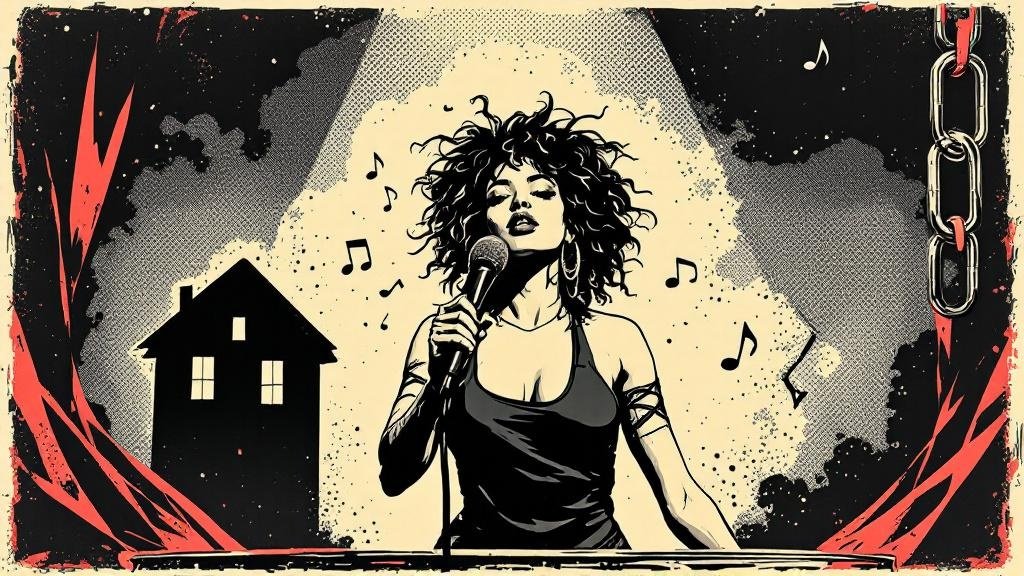
In the past year, Brazil recorded 1,568 cases of femicide, the highest number since the crime was classified, marking a 4.7% increase compared to the previous year. Despite a scenario marked by worsening gender violence, the growing presence of women in national rap highlights the use of music as a tool for denunciation, expression, and resistance.
A significant portion of crimes against women occur at home, often committed by partners, ex-partners, or family members. Data from the Brazilian Public Security Forum shows that 62.6% of victims are Black women, underscoring the structural inequality and greater socioeconomic vulnerability faced by this segment of the population, often with less access to protection networks and effective public policies.
In this context, cultural expressions have played an important role in exposing these violences. Rap, in particular, stands out for its origins in marginalized contexts and its ability to translate social experiences into accessible and direct language. More than depicting reality, the genre acts as a space for collective elaboration of these experiences, contributing to broadening public debate.
According to Diósnio Machado Neto, a professor in the Graduate Program in Musicology at the Department of Music of the School of Communications and Arts (ECA) at USP, rap emerged in a context of social marginalization, especially in urban communities marked by inequalities. “Rap emerged in 1970, as part of hip-hop, in New York City. Its social function at that time was to create forms of gathering, provide visibility, and collective self-inscription of an identity based on the Black and Latino experience in degraded urban spaces,” he states.
The professor notes that this characteristic has persisted over time, even with the genre’s transformations. In Brazil, rap adapts to the country’s social and cultural specificities, highlighting issues such as structural racism, social inequality, and urban violence.
“In Brazil, it is constituted from multiple cultural layers, symbolically reconfigured. These are movements that emerge in contexts of severe urban inequality, police violence, and precarious living conditions,” Machado explains.
The professor also emphasizes that the growth of female rap goes beyond numbers. For him, the presence of women in rap does not adapt to the scene but transforms it. “The trend is not for female rap to gain relevance only when it adapts to the dominant model, but for it to transform the very criteria by which it is measured, what counts as a social experience worthy of being heard. Its historical strength perhaps lies precisely in not repeating the already established center, but in displacing it.”
Beyond the lyrics, the way these narratives are constructed also influences how society perceives gender violence. According to Professor Sérgio Kodato from the Faculty of Philosophy, Sciences, and Letters of Ribeirão Preto (FFCLRP) at USP, the social understanding of a problem is not only through data but also through the symbolic forms that represent it. “When women narrate their own experiences, it creates an important inversion. They cease to be objects of discourse and become subjects,” he says.
“Rap, by narrating concrete experiences, especially of historically marginalized groups, acts as a symbolic mediator, organizing perceptions, emotions, and interpretations of the social world. In the case of gender violence, it can make visible what is often naturalized or silenced,” Kodato explains.
By mobilizing emotion and identification, music can provoke a type of engagement different from that produced by purely rational information. “When women recognize themselves in rap narratives, a process occurs that we call subjective validation. This can help name situations of violence that were previously confusing or minimized. Additionally, it strengthens the sense of belonging and reduces isolation, which is one of the factors that sustain the maintenance of violence. This identification can favor empowerment processes by showing possibilities of confrontation and resistance,” he states.
This process is especially relevant in contexts where violence tends to be naturalized or invisibilized. By making these experiences more visible, rap contributes to sustaining discourses and expanding the social debate on the topic. Even with the greater insertion of women in the cultural industry, this critical function remains, reinforcing the role of music as a space for expression.
It is in this scenario that the growth of female rap stands out. By occupying a space historically dominated by men, these artists not only gain visibility but also transform the content and reach of rap. Their productions often articulate personal and collective experiences, bringing their experiences to light.
For MC Poeta Gabriela, this movement plays a fundamental role in building social awareness. “Rap made by women has been the escape valve for transforming the current scenario. I see that we have much more social awareness in the lyrics, much more criticism, and capacity for narrative construction,” she states.
The lyrics produced by women directly dialogue with the reality of many Brazilian women, creating identification and strengthening public debate. By addressing themes such as domestic violence, autonomy, and inequality, female rap contributes to broadening the social understanding of these issues.
“Rap can also be an empowerment tool. It was like that for me; I empowered myself through the word, through the literature that hip-hop provides,” says Gabriela. This process of self-confidence can be an important step both for recognizing violence and for breaking abusive cycles.
The strengthening of female rap also accompanies broader changes in the cultural scene, with the growth of collectives, rhyme battles, and independent productions led by women. This movement expands access to cultural production and strengthens the circulation of diverse narratives, contributing to renewing the genre itself and expanding its forms of action.
Source: Jornal da USP.
Original published at O Cafezinho.