
Exports hit record despite Trump tariff hike, even as volumes fall, driven by a surge in international prices.
Brazil exported US$16 billion in coffee in 2025, a historic record. The figure is even more striking given that the increase occurred despite a decline in export volumes. In physical terms, the country shipped about 41.5 million 60-kilogram bags, combining green coffee and soluble coffee in green-bean equivalent — a contraction of roughly 17% compared to 2024. The record, therefore, did not come from higher volumes, but from a sharp rise in international prices.
According to data from the Foreign Trade Secretariat, export revenues grew 31% year over year and 168% compared to a decade earlier.
The performance came despite the tariff hike imposed by Donald Trump, who between August and November 2025 applied a 50% surcharge on Brazilian coffee entering the United States. The tariff was only lifted after direct negotiations between Lula and Trump, preventing more severe impacts on the world’s second-largest coffee-consuming market.
Of the total exported, 93% corresponded to green coffee — the raw, unprocessed bean —, 7% to soluble coffee, and less than 1% to roasted coffee.
Coffee’s share of Brazilian exports reached 4.3% in 2025, up from 3.4% the previous year. In 2003 and 2004, this indicator had fallen to 1.8%, the low point of the historical series. The recovery over two decades has more than doubled coffee’s weight in Brazil’s export basket.
Traditional markets still dominate purchases of Brazilian coffee. Germany leads with US$2.3 billion, up 27% year over year and 118% over the decade; the United States comes second with US$1.9 billion, flat on the year but 62% higher than ten years earlier; Italy, Japan, and Belgium round out the top five buyers. All figures in this paragraph refer exclusively to Brazilian green coffee exports.
Countries of the so-called Global North — Western Europe, the United States, Canada, Japan, South Korea, and Australia — accounted for 77.5% of Brazil’s green coffee exports in 2025, a still-robust share but one in decline: in 2015, this group represented 87%. These are mature markets, where per-capita consumption is already high and room for expansion is limited.
The plant that sustains this market emerged more than 600,000 years ago in the forests of Ethiopia, when the dominant human species was still Homo heidelbergensis, the common ancestor of modern humans, Neanderthals, and Denisovans. Homo sapiens would only appear some 300,000 years later. The first documented human use of coffee dates back to the 15th century among Sufi monks in Yemen, who discovered in the dark infusion an ally for long nights of prayer — caffeine works by blocking adenosine receptors in the brain, the neurotransmitter that induces sleepiness.
Coffee arrived in Brazil in 1727, brought from French Guiana by Francisco de Melo Palheta. The first commercial plantations were established in the Paraíba Valley, between Rio de Janeiro and São Paulo, under the slave system. From the 1870s onward, production exploded in western São Paulo — this time with free labor and strong participation by Italian immigrants — and coffee became Brazil’s first major export commodity under a wage-labor regime. Coffee profits financed railroads, modernized the Port of Santos, and laid the foundations for São Paulo’s industrialization.
The dynamics change when the focus shifts to the Global South. China, Russia, Turkey, and other emerging economies accounted for 22.5% of Brazilian coffee exports in 2025, up from just 13% in 2015. Growth reached 42% in a single year and 363% over the decade — a pace nearly three times faster than that of traditional markets.
The individual figures are striking. Compared to ten years earlier, Brazilian coffee exports increased 3,430% to China, 1,189% to Saudi Arabia, 767% to the United Arab Emirates, 588% to Russia, 546% to Malaysia, 497% to Taiwan, and 403% to Turkey. These are markets that are only now discovering coffee.
There is a revealing data point: in 2025, Colombia, Mexico, and Vietnam recorded explosive increases in imports of Brazilian coffee. The pattern suggests trade triangulation — faced with high tariffs imposed by the United States, American importers began purchasing Brazilian coffee via third countries, which buy the beans from Brazil and re-export them, circumventing Donald Trump’s punitive tariff hike.
China is the grand prize. Chinese per-capita coffee consumption stands at just 0.26 kilograms per year — 24 times lower than Brazil’s 6.26 kilograms. If China drank coffee at the same rate, demand would reach 144 million bags per year, nearly the entire world’s production.
The country is already showing clear signs of awakening. Shanghai has become the city with the largest number of coffee shops in the world, with 9,115 establishments in 2024, surpassing London, New York, and Tokyo. The Chinese chain Luckin Coffee ended the year with more than 30,000 stores, overtaking Starbucks. Coffee has ceased to be an expatriate curiosity and has become an urban habit.
According to Chinese customs data, China’s green coffee imports totaled US$1.46 billion in the 12 months through November 2025, an increase of 72% compared to the previous period.
Ethiopia became China’s largest supplier, with 32.1% of total imports, slightly ahead of Brazil, which accounted for 31.1%. Ethiopian sales to China surged 328% in a single year, while Brazilian exports grew 48.6%. There is, however, a physical limit to Ethiopia’s advance: the country produces about 8 million bags per year, compared with 63 million in Brazil. If Chinese consumption accelerates consistently, growth will necessarily depend on Brazilian coffee.
Coffee has a unique characteristic: it functions as an anchor product, capable of opening up much broader urban markets. Coffee shops do not sell coffee alone. They sell food, beverages, space, time, comfort, sociability, and services — tables, chairs, restrooms, Wi-Fi, air-conditioned environments. Coffee is the gateway to this entire ecosystem.
The global coffee market generates between US$270 billion and US$486 billion per year, depending on methodology. Worldwide exports of green, roasted, and soluble coffee totaled US$51 billion in 2024. The gap does not represent a loss, but rather the existence of service and consumption chains organized around the beverage.
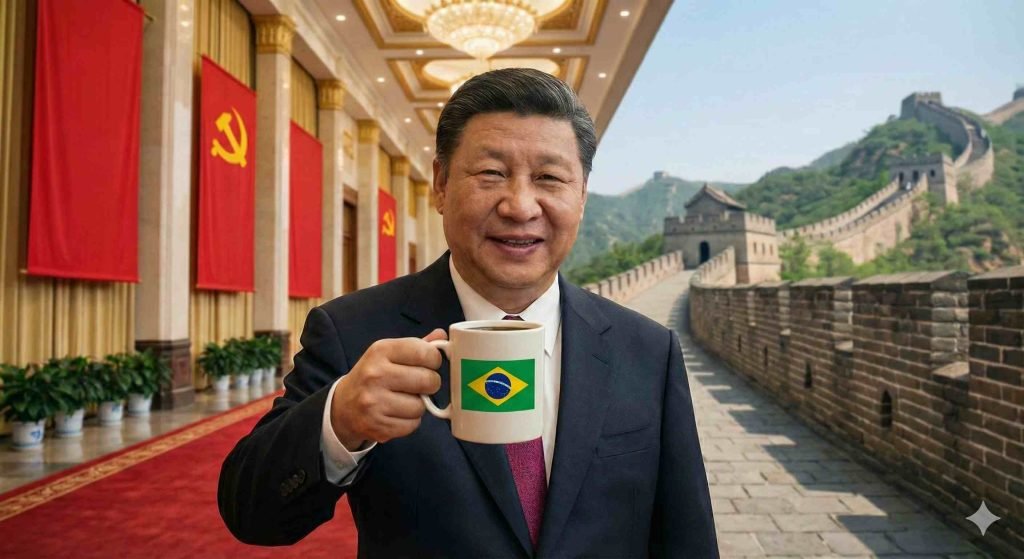
Luckin Coffee has signed contracts worth US$2.5 billion to purchase Brazilian coffee through 2029. In December 2025, the “Café do Brasil” brand appeared on 400 million cups sold in Luckin stores — roughly 14 million per day.
Global coffee production in the 2024/25 crop year reached 175 million bags, according to the USDA. Brazil dominates both main segments — 44% of the world’s arabica and 28% of robusta — and accounted for 37% of global production. Beyond being the world’s largest producer and exporter, Brazil is also the second-largest consumer by volume, with a domestic market of 22 million bags per year. On a per-capita basis, however, Brazil outdrinks Uncle Sam: 6.26 kilograms per person, versus 4.9 kilograms in the United States.
From a social perspective, coffee distributes income like few other crops. In Brazil, there are 287,000 producers across 1,900 municipalities, covering a total area of 1.9 million hectares. About 78% are family farmers. Worldwide, 25 million families depend on coffee — nearly all on smallholdings.
Behind these numbers lies more than a century of science applied to agriculture. Modern farming is not backwardness; it is industry under open skies. Brazilian coffee carries decades of research, knowledge, and technology in every bag. And as the Global South drinks more coffee, the sector is poised to generate even more income, jobs, and social stability — especially in rural areas.