
EBC

South American and European authorities took advantage of the signing ceremony of the free trade agreement between Mercosur and the European Union on Saturday (17) in Paraguay to defend multilateralism and free trade as engines of economic development.

In his speech, the president of the European Council, António Costa, said that the signing of the treaty negotiated over the last 26 years reaffirms the belief of the member states of the two regional blocs in fair trade and multilateralism.
Related news:
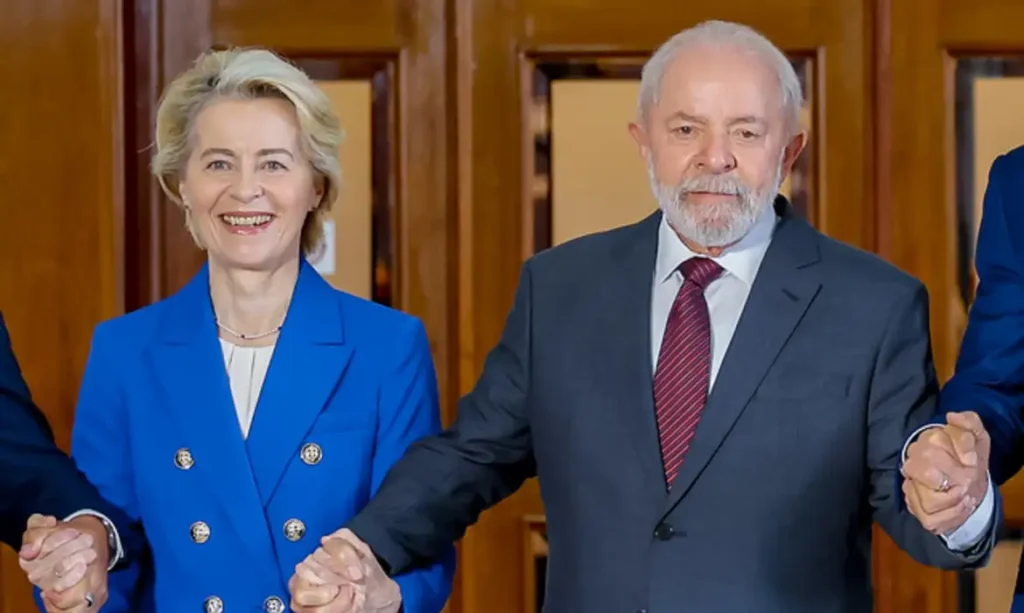
- Lula and Ursula stress that Mercosur-EU agreement will benefit everyone.
- Mercosur-EU agreement should enter into force in 2nd semester, says Alckmin.
- Understand the Mercosur-EU agreement in 13 points.
“With this agreement we are sending a clear message to the world, in defense of free trade based on rules, and [in favor of] multilateralism and international law as the basis for relations between countries and regions,” said the president of the council, pondering that even though it has taken time, the treaty “comes at an opportune moment.”
“Because this agreement is a bet on openness, exchange and cooperation, in the face of [threats of] isolation and the use of trade as a geopolitical weapon. […] With it, we do not aspire to create spheres of influence, but rather spheres of shared prosperity, based on trust, cooperation and respect for the sovereignty of our democracies. We intend neither to dominate nor to impose, but rather to promote and strengthen the links between our citizens and our companies in order to create wealth in a sustainable way, protecting the environment and environmental rights.”
The president of the European Commission, Ursula von der Leyen, reinforced Costa’s assessment by saying that the act has the potential to connect continents and create the largest free trade area in the world, with a market of 700 million people. “We chose fair trade over tariffs. We chose long-term partnerships over isolation,” Ursula said.
Host of the event, Paraguayan President Santiago Peña highlighted the diplomatic pragmatism needed to overcome 26 years of deadlock. “We are facing a truly historic day, long awaited by our peoples, [capable of] uniting two of the most important global markets, and which demonstrates that the path of dialogue, cooperation and fraternity is the only way forward,” said Peña, highlighting the efforts of Brazilian President Luiz Inácio Lula da Silva – who, due to scheduling issues, was unable to travel to Asunción – and Ursula von der Leyen for the success of the negotiations. “Without President Lula, we might not have reached this day. He was one of the key players in this process.”
Argentine President Javier Milei stressed that the agreement is a starting point for exploring new trade opportunities and the basis for greater regional integration, based on free trade. According to the Argentine president, the promotion of macroeconomic stability and legal predictability are indispensable conditions for prosperity and social justice.
<p
“But for this to happen, it is essential that, during the implementation stage of the agreement, the spirit of what has been agreed is preserved. The [possible] incorporation of restrictive mechanisms, such as quotas, safeguards or equivalent measures, would significantly reduce the economic impact of the agreement, undermining its essential objective,” Milei pondered, encouraging the South American and European countries that signed the agreement to continue advancing on new fronts of trade openness.
The agreement will be implemented in the near future.
Original Article: Líderes do Mercosul e da UE assinam acordo e defendem multilateralismo
Author: Alex Rodrigues – Repórter da Agência Brasil