
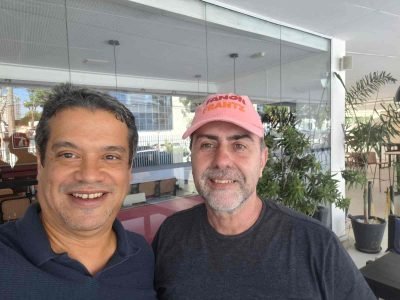
“We exceeded every expectation and turned 2025 into the greatest year in the history of international tourism in Brazil. We took to the world the brand of our authenticity, our diversity, the Brazilian soft power that has so deeply enchanted the planet,” Marcelo Freixo, president of Embratur, told us in an exclusive interview at a restaurant in Niterói a few days ago.
In 2025, Brazil broke its own historical barrier, recording the arrival of 9.3 million foreign tourists. The figure represents a 37.1% jump compared to 2024 and shatters a record that, since 1974, when the historical series began to be measured, had stubbornly remained stuck below 7 million visitors.
Global tourism, after the pandemic shutdown, is living through an era of reinvention. In 2025, the sector contributed nearly 12 trillion dollars to global GDP and generated more than 370 million jobs worldwide.
In Brazil, tourism already accounts for 8% of GDP. The number is striking because it approaches the 12% generated by oil, traditionally seen as the country’s main economic engine. It is a quiet but profound structural shift, repositioning Brazil not only as an exporter of commodities, but as a key player in a global services economy.
Trends for 2026 point to changes in the profile of the global traveler. Ecotourism is gaining strength, and here Brazil stands out with its six preserved biomes. Brazilian culture, with its gastronomic, musical, and ethnic diversity, is also increasingly attracting tourists in search of authenticity.
As the post-pandemic world rediscovers the pleasure of traveling, the country seems, at last, to be translating its vast potential into concrete numbers.
Read below excerpts from the interview.
Miguel do Rosário: What was the situation of Embratur and Brazilian tourism in general when you took on this mission in 2023?
Marcelo Freixo: Brazil’s image was at its worst. An image of denialism, of mishandling the pandemic—which was a global issue—and of environmental devastation, especially the fires. So Brazil’s image abroad was extremely negative.
That was already the first challenge. When President Lula appointed me to lead Embratur, he was very clear: he would dedicate his first year to restoring Brazil’s image in the world, traveling extensively, and he wanted Embratur to be active in promoting Brazil. But Embratur itself had been severely damaged by the previous administration.
Under the Bolsonaro government, Embratur was transformed from an autarchy (a traditional public agency) into a semi-autonomous agency. The idea could have been good, but the original project предусмотрed that 5% of SESC and SENAI funds would finance the agency (which never actually took effect), following the model of Apex. However, when the bill was voted on in Congress, this transfer of resources was dropped. They created an agency with no budget: without the autarchy’s funding in the federal budget and without the 5% from the so-called “System S” (Brazil’s network of employer-funded vocational and social institutions). When I arrived, there was enough cash on hand to cover only four months of salaries. That was the situation.
Miguel do Rosário: How did you solve this budgetary puzzle?
Marcelo Freixo: First, I went to talk to the government. I have good relationships, so I went to Fernando Haddad, Simone Tebet, and Geraldo Alckmin—who is a major ally and has a very solid vision for tourism. I explained that it made sense to keep the agency model, which is less rigid, but that we needed a solution.
The solution came in parts. First, Embratur already had a partnership with Sebrae for international trade fairs. We managed to more than double that amount, which expanded our actions but did not solve payroll. Then we negotiated a direct transfer from the Ministry of Tourism, restoring a portion of public funding while maintaining the agency status. And finally, we secured a percentage of revenue from sports betting (legal online betting platforms, known in Brazil as “bets”) for our budget. It took me a year to resolve, but today payroll is up to date and we have resources for international promotion.
Miguel do Rosário: Brazil reached 9.3 million tourists in 2025, a historic record. But France alone receives around 90 million visitors a year. Why is the gap so large? Does Brazil have a chance of getting closer to those numbers?
Marcelo Freixo: You can’t really compare Brazil with Europe. First, Brazil is twice the size of all of Europe in terms of territory. France sits in the middle of Europe—you can cross the entire continent in five hours. In five hours, you can’t even cross Brazil.
And from the European market to Brazil, you have an ocean in between. There’s a study showing that 86% of international trips last no more than five hours. So an international trip for a European means traveling across Europe, but it doesn’t get them to Brazil.
The fact that Brazil is in South America means we have to be compared, in terms of international tourism numbers, to South America. And today, Brazil is the largest international tourism destination in all of South America and Central America, second only to Mexico.
And Mexico is very close to the United States, receiving a massive flow of American tourists because it’s practically next door. So distance and geography are far more decisive in international tourism than people tend to imagine.
We had never surpassed 6.5 million visitors—the record was there. Now we’ve reached 9.3 million.
Miguel do Rosário: And how did this new structure and resolved budget translate into concrete actions?
Marcelo Freixo: The real breakthrough was technical. We set up two strategic centers within Embratur: a data intelligence center, staffed with some of the best people in Brazil in innovation and tourism, and a transportation and connectivity center, with professionals experienced in major airports like Galeão and Guarulhos.
The data center tells us everything: who comes, how much they spend, when they come, where they go. We have an online dashboard available to any guesthouse owner, mayor, or local tourism secretary. Embratur has become a reference center. All of our policy is based on data-driven planning. I know where Italians go, where the French go, what they consume, when they travel, and the best time to promote Brazil abroad.
The transportation center gives us a direct relationship with all airlines. That allows us to act very precisely. For example: Argentinians traditionally traveled to Búzios, Florianópolis, and Rio Grande do Sul. Our data showed they could expand into the Northeast. We went to the airlines and made direct flights from Argentina to Fortaleza viable. The number of Argentine tourists grew by 80% in one year. Of the 9 million tourists in 2025, 3 million came from Argentina.
Miguel do Rosário: And the international marketing plan?
Marcelo Freixo: The last time Brazil had an international marketing plan was in 2004, the Aquarela Plan, created by Eduardo Sanovicz, who was Embratur’s first president. Twenty years ago. In twenty years, a lot changes—the country changed completely.
So we created a new international marketing plan, the Brasis Plan. Brazil is a unique country, but it isn’t just one Brazil. We took that plan and adapted it to each state.
Our technical team went to every state capital to launch a specific marketing plan for that state. For example, where can Minas Gerais attract international tourism from? Chile, France. We already know which international tourists can go there, we already bring in the airlines that could operate those flights, and we already engage local government and the private sector.
We did this in all 27 states. It’s a public policy effort that Brazil had never undertaken. That’s why growth is happening in every state. There isn’t a single region in Brazil that hasn’t grown.
Miguel do Rosário: You mentioned the importance of going beyond the obvious destinations. Are there examples of this innovation?
Marcelo Freixo: We significantly expanded Brazil’s capacity in new tourism products. We’ve always had enormous potential for Afro-tourism, but it was never developed as a product. We brought together everyone working with Afro-tourism and began training and structuring it with them.
Data intelligence showed that there is a very strong African American tourism market in the United States that travels to Africa. Why not to Brazil, which is the largest Black nation outside of Africa?
We went to Ghana, Nigeria, South Africa, and brought tour operators to see Bahia and Rio. The result is that we more than doubled the number of tourists from those countries.
There’s also the Samba Route in Oswaldo Cruz, a neighborhood in Rio. It’s a project that starts at the house of Candeia, one of Brazil’s most important samba composers. Before, you could walk by and not even know it was there. We brought in the collective Negros Muros, they painted Candeia on the wall, and we added an innovation.
Today, when you get there, there’s a QR code. You scan it on your phone and get Candeia’s full playlist and information about him in two languages. There are 10 points that tell the history of samba and the Portela samba school, passing through Portelinha, the cradle of Nozinho where Walt Disney once visited, and the story of Paulo da Portela. It ends at Portela’s headquarters.
Oswaldo Cruz is now receiving a huge number of tourists because of the Samba Route, with guides who are women from the local community, trained in tourism and now working there. I’m not talking about Christ the Redeemer or Ipanema. I’m talking about Oswaldo Cruz. Tourism has the power to redefine the meaning of territories.
Miguel do Rosário: This dimension of tourism as a job creator seems central. How do you see this?
Marcelo Freixo: Tourism isn’t about who travels; tourism is about who receives. Because if I think tourism is about who travels, I see it as a privilege, something for a few people. But I’m talking about 8 million businesses. I’m talking about first jobs for a lot of people.
My first job was delivering newspapers on the street. Nobody does that anymore. My second job was as a bank clerk, which today is also rare because bank branches have moved to smartphones.
So today, the first job is in a bar, a restaurant, a hotel, a guesthouse. It’s in tourism. Tourism generates jobs, not to mention informal work.
And there’s no replacement by AI. On the contrary. I can solve everything on my phone today, but if I want to visit a place, I can’t do that through my phone. Innovation actually makes it easier for people to move around the world.
Miguel do Rosário: And how does this connect with other creative industries?
Marcelo Freixo: We discovered that 44% of Americans travel to places they’ve seen in a movie or a TV series. So today there’s a very direct relationship between tourism and audiovisual content. New Zealand invested in this, South Korea invested, Spain invested. You walk through Madrid today and there’s someone dressed as a character from Money Heist on the street.
So what did I do? I went to the Ministry of Culture, with Minister Margareth Menezes and Secretary Márcio Tavares, and said: we need to create a national film commission. A Brazilian film commission. Because we already have film commissions in Rio de Janeiro, São Paulo, and more than 20 others across the country, but they’re municipal or, at most, state-level.
Brazil doesn’t have a national film commission to attract productions here. And now, in March 2026, a Brazilian film commission will be created, as a result of this study on the relationship between tourism and audiovisual industries.
Miguel do Rosário: Is there a broader strategic vision behind this?
Marcelo Freixo: Every oil-producing country today is investing in tourism. Saudi Arabia—everyone is investing heavily in tourism. Because they already understand that, before long, tourism will be a major source of revenue.
We have six biomes, we have an incredible country. We need to place tourism in a more strategic drawer. Tourism is not a detail. Tourism is not leisure. And our political field still thinks about tourism in a very limited way.
I used to be one of those people too, which is why I understand. When I went to Embratur, I was shocked, because I started studying it and realized: wait, we’re dealing with something huge here. This is the great solution for the development model we have.