

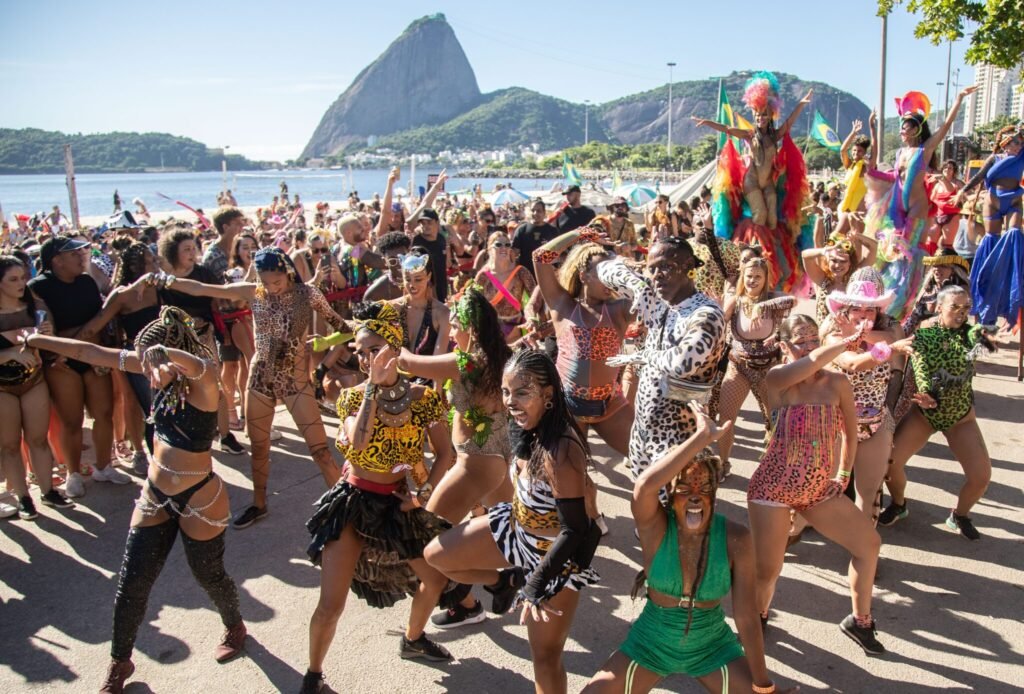
Rio de Janeiro — Carnival 2026 ended days ago, but Brazil’s tourism industry is still taking stock of what may have been one of the country’s strongest post-pandemic holiday seasons yet.
Early balance sheets shared by Embratur, Brazil’s national tourism agency, and highlighted publicly by its president Marcelo Freixo, suggested that the Carnival season moved an estimated R$ 18.6 billion across Brazil’s economy — a figure that includes everything from lodging and transportation to food, entertainment, and the vast network of small businesses and informal workers that power the celebration.
Just as telling for the international market: Freixo said the country welcomed an estimated 300,000 international tourists during Carnival, about 17% more than in 2025. The industry is still awaiting consolidated results from local authorities, operators, and national reporting, but the early read is consistent with what airlines and the hospitality sector were signaling well before the first parade began: Brazil’s biggest cultural export is once again functioning as a high-impact economic engine.
That impact goes far beyond the stadium lights of Rio’s Sambadrome. Carnival is not a single-city product, and it has increasingly become a multi-stop trip for foreign visitors — a week split between Rio’s parades, Salvador’s street circuits, Recife and Olinda’s traditions, plus beach destinations and nature add-ons that turn a holiday into a longer stay. When international travelers extend their itineraries, the spending spreads — from hotel jobs and restaurants to guides, drivers, costume workshops, bars, and the countless vendors who rely on the season’s surge in foot traffic.
Freixo framed the season as a reminder that Carnival is not only Brazil’s signature celebration — it is also a serious economic event, generating work and income for thousands of families. He pointed to the presence of President Luiz Inácio Lula da Silva in Carnival events in multiple cities — a symbolic show of political support for a cultural industry that has become a global calling card and a pipeline for tourism dollars.
What the numbers suggest — and what still isn’t final
Because the Carnival economy is so decentralized, the most reliable national totals often arrive in stages. That’s why tourism authorities and industry groups are careful to treat early figures as estimates, subject to revision.
Even so, Embratur’s pre-Carnival outlook had already projected a meaningful lift on the foreign-spending side. Before the festivities, the agency estimated that international tourism tied to Carnival would generate about US$ 185.7 million in visitor spending — up roughly 10% from the prior year. With Freixo now pointing to around 300,000 foreign visitors and a double-digit year-over-year increase in international arrivals, the post-event narrative fits the same direction: more foreigners came, and the tourism economy captured more value.
In other words, even if the exact final totals move up or down as reporting is finalized, the trend line appears hard to dispute. Brazil’s Carnival is not just back — it’s expanding.
Why this matters now: Brazil’s tourism rebound has been accelerating
Carnival 2026 didn’t happen in a vacuum. It landed at a moment when Brazil’s inbound tourism has been climbing sharply, shifting from pandemic recovery to something closer to a full-scale growth cycle.
After COVID-19 crushed international travel globally, Brazil — like many destinations — spent years rebuilding routes, confidence, and demand. But in the last two years, the rebound has looked less tentative. Tourism authorities have pointed to record or near-record arrival totals and a surge in foreign-currency receipts, arguing that Brazil has been regaining competitiveness in the global market.
That matters to policymakers because international tourism is a rare sector that combines job creation with foreign-exchange inflow. When Brazil pulls in visitors from abroad, it doesn’t only fill hotel rooms — it also brings in hard currency that strengthens local economies far from the financial centers, especially in cities where seasonal tourism is one of the few fast-moving sources of income.
Carnival is the perfect “stress test” for that recovery because it concentrates demand into a tight window. If airports, hotels, local transport, and public services hold — and visitors still report positive experiences — the event becomes its own marketing campaign for the next trip.
The “brand Brazil” question — and the shadow of the Bolsonaro years
Tourism isn’t driven only by beaches and festivals. It’s also driven by perception — and Brazil’s global image has whipsawed over the past decade.
The pandemic explains the sharpest drop in international arrivals and airline connectivity. But many tourism professionals argue that Brazil also faced a “brand problem” in the years that overlapped with President Jair Bolsonaro’s administration. International coverage during that period often focused on political polarization, institutional tensions, and environmental controversy — headlines that can make long-haul travelers hesitate, especially in higher-spending markets where reputation and values are part of destination choice.
No single factor decides where Americans, Europeans, or Asians book their next vacation. But tourism is emotional, and emotion follows storylines. When a country’s story becomes dominated by conflict and controversy, it can raise the perceived “friction” of travel — even if the beaches haven’t changed.
Under the current administration, Embratur has pushed a more explicit effort to reposition Brazil abroad — not only as joyful and culturally rich, but also as open, stable, and increasingly aligned with sustainability narratives that resonate in major international markets. Carnival, in that sense, does double duty: it’s celebration and soft power at the same time.
The U.S. market: recovering, but vulnerable to friction
For an international audience, one of the most revealing data points in Brazil’s tourism story is the United States.
American travel to Brazil fell sharply during the pandemic years — as it did almost everywhere — and while it has been rebuilding, the U.S. market is structurally more sensitive than South American demand. Long flights, higher airfares, fewer spontaneous trips, and the need for careful planning all increase the odds that a traveler chooses an easier alternative.
That’s one reason Brazil’s recent surge has been powered so strongly by South America, where trips are shorter, cheaper, and more repeat-friendly. Argentina has remained a dominant source of visitors, and other neighbors have been growing quickly — a pattern that helps stabilize arrivals even when global long-haul travel becomes more expensive.
But Brazil still wants the U.S. market to grow — not only for volume, but because Americans tend to stay longer and spend more per trip. That’s why any additional “speed bumps” matter. Entry requirements, paperwork, or uncertainty can quietly reduce bookings at the margin, especially for leisure travelers comparing Brazil to destinations that require fewer steps.
Carnival 2026’s estimated 300,000 international visitors suggests Brazil’s appeal to foreign travelers is broadening — and that, even with long-haul sensitivities, the country is still managing to pull in growing numbers of global visitors when it offers a must-see moment.
Why Carnival keeps winning: culture sells — and Brazil knows it
Carnival’s economic importance isn’t just the size of the event. It’s the type of experience it represents.
In a world of destinations competing for attention, Brazil’s advantage is that it isn’t selling a theme park version of culture — it’s exporting a real, living tradition. International travelers don’t come only to watch; they come to participate. And participation drives spending: costumes, classes, tours, local transport, extra days in the city, domestic connections to other destinations, and repeat visits.
That’s also why the “international tourist” number matters so much. A 17% year-over-year increase in foreign arrivals for Carnival isn’t just a nice statistic — it’s a signal that Brazil is converting global curiosity into real trips. And when those visitors leave with positive stories, they become the next cycle of promotion, without the country having to buy the ad space.
The bottom line
With final numbers still being consolidated, Brazil’s tourism leaders are careful to describe the early totals as estimates. But the first broad picture is already emerging.
Carnival 2026 likely moved about R$ 18.6 billion through Brazil’s economy, and it likely brought in around 300,000 international tourists, about 17% more than in 2025, according to Embratur president Marcelo Freixo. Those figures, paired with Embratur’s pre-event projections for foreign spending, support a wider conclusion the industry has been leaning into: Brazil’s tourism rebound is no longer only a recovery story.
It’s becoming a momentum story — one built on culture, improved connectivity, and a deliberate attempt to rebuild the country’s image abroad after years when the global narrative often worked against it.
And for Brazil, there may be no better proof of that shift than the fact that the party ended — but the numbers, once again, kept dancing.