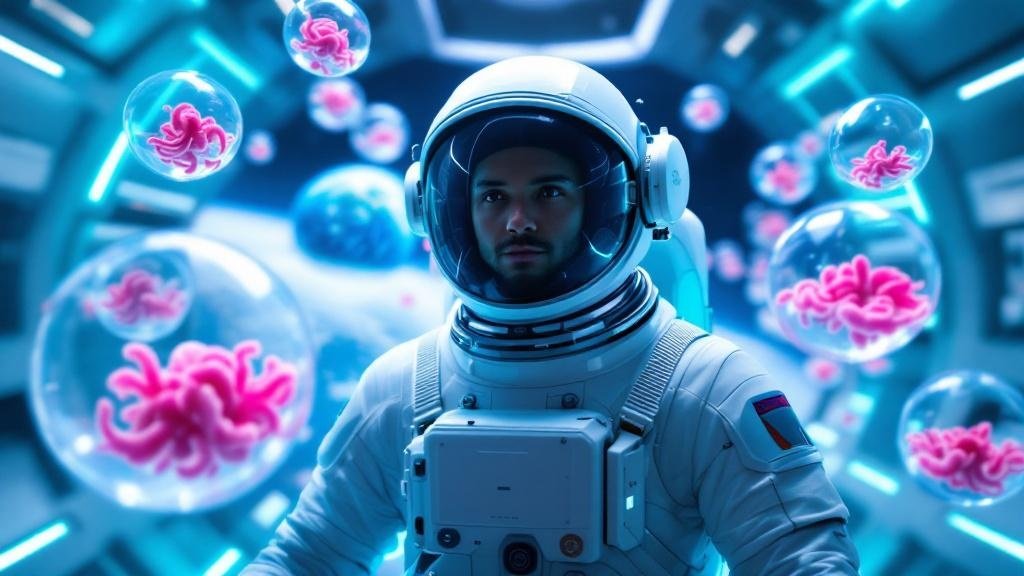
An innovative space mission is set to send worms into space with the aim of enhancing astronaut health on long-duration missions.
On April 10, 2026, a team of British scientists will send a special payload aboard Northrop Grumman’s Cygnus vehicle to the International Space Station (ISS). According to Space.com, the experiment seeks to understand how the worms of the species Caenorhabditis elegans adapt to the extreme conditions of space, such as microgravity and radiation, to identify biological mechanisms that could protect space explorers.
These tiny organisms, about 1 millimeter in length, will be housed in Petri dishes within a compartment measuring 10 by 10 by 30 centimeters.
Initially, they will remain inside the station for an acclimatization period. They will then be subjected to controlled conditions simulating the challenges of the space environment for up to 15 weeks. During this time, automated cameras will record the worms’ health in real time, capturing microscopic fluorescent signals emitted by their cells.
This automated system is designed to require no direct intervention from the astronauts aboard the ISS, saving time and eliminating the need for specialized monitoring skills.
A representative from the UK Space Agency highlighted the importance of studying cellular and genetic changes in living organisms in space. This analysis allows for the collection of precise data on the risks that space flights pose to human health.
Developed by researchers from the universities of Exeter and Leicester in the UK, the project not only opens new frontiers for biological research in space environments but also contributes to the safety of future manned missions to the Moon and Mars, aligning with long-term exploration goals.
Tim Etheridge, a researcher at the University of Exeter, emphasized that NASA’s Artemis mission marks the beginning of a new era of human exploration, with ambitious plans for extended stays on the Moon. He explained that understanding how the human body reacts to deep space conditions is essential for the success of these initiatives.
Studies with the worms may reveal biological processes capable of mitigating negative impacts on astronauts’ bodies, bringing humanity closer to the possibility of establishing a lasting presence on other celestial bodies.
The challenges faced by astronauts on space missions are numerous and severe. These include bone and muscle mass loss, vision problems, reduced red blood cell count, and increased cancer risk due to cosmic radiation exposure.
With growing interest in establishing permanent bases on the Moon and, eventually, Mars, it is imperative to develop effective strategies to protect explorers from the debilitating effects of prolonged space travel. This experiment represents a significant step in that direction, using simple organisms to uncover solutions that could directly impact human health in space.
The initiative also reflects international collaboration and the advancement of science in support of space exploration. By studying the effects of the extraterrestrial environment on living organisms, scientists hope not only to protect astronauts but also to expand knowledge of biology under extreme conditions, paving the way for safer and more sustainable missions in the future.
Original published at O Cafezinho.