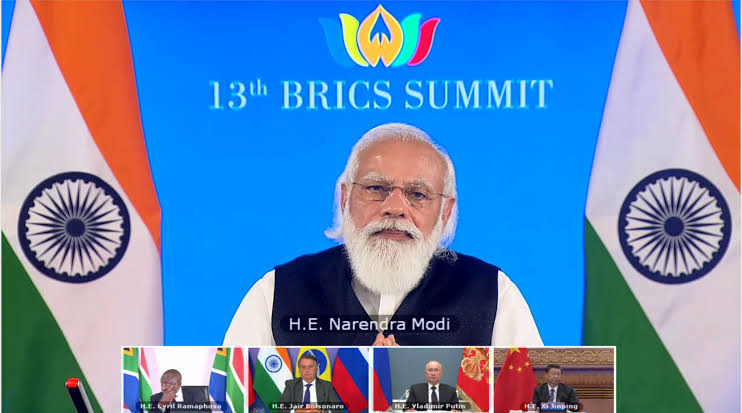
India aims to connect the digital currencies of BRICS countries, a proposal that could transform trade and tourism among major emerging economies.
The initiative originates from the Reserve Bank of India, advocating for an integrated system among sovereign digital currencies, known as CBDCs.
The goal is straightforward: to enable international transactions without involving the dollar, thereby eliminating intermediary steps and reducing costs.
Currently, even when two countries do not involve the United States, most global operations still rely on the dollar as the settlement currency.
This creates structural dependency. Any change in U.S. monetary policy directly impacts emerging economies.
The Indian proposal seeks to break this pattern.
The idea is to connect existing systems. China, India, and other BRICS members are already developing their digital currencies in pilot projects.
The plan is to make them interoperable, allowing them to communicate with each other in real-time.
In practice, a Brazilian company could pay an Indian supplier directly in digital currencies, without converting to dollars.
The impact extends beyond trade.
The project includes tourism. A Brazilian citizen could travel to India or China and pay directly with national digital currency, bypassing traditional exchange rates.
This reduces fees, speeds up payments, and enhances economic integration among the countries.
The movement occurs within a larger context.
According to IMF data, BRICS countries already represent over 40% of the global economy in purchasing power parity.
Thus, there is sufficient scale to support a parallel financial system.
However, the challenge is technical.
Each country has developed its digital currency with its own architecture. Integrating these systems requires standardization, security, and complex multilateral agreements.
There are also governance issues. Who controls data, settlement, and system rules remains open.
Nonetheless, the project does not start from scratch.
BRICS is already working on initiatives like BRICS Pay, a system aimed at direct payments between bloc countries.
India’s proposal could be the next step, moving from a payment system to an integrated monetary infrastructure.
On the geopolitical front, the impact is significant.
The United States has already reacted to similar movements, warning against attempts to circumvent the dollar.
This highlights the scale of the dispute.
It is not just about financial technology. It is a power struggle within the global system.
For Brazil, the issue is strategic.
The country is already developing the digital real and could directly benefit from an integrated system, reducing costs in foreign trade.
It could also strengthen relations with China, India, and other partners without relying on traditional financial intermediaries.
At the same time, it requires preparation.
Without technological infrastructure and regulatory coordination, Brazil might remain just a user of the system, not a protagonist.
India’s move reveals a structural shift.
The financial world is beginning to migrate from dominant currencies to interoperable networks.
If successful, this proposal does not create a single BRICS currency.
But it could create something more significant.
A payment system capable of operating outside the dollar axis.
Original published at O Cafezinho.