The study Mapa Autismo Brasil (MAB), the first national sociodemographic profile on autistic individuals, released on Thursday (9), reveals that access to diagnosis and therapies in Brazil remains limited.
Launched by the Instituto Autismos, the research surveyed autistic individuals and caregivers across all states to identify the profile of Brazilian autistics and the services they can access.
The study collected 23,632 online interviews between March 29 and July 20, 2025, including responses from 16,807 caregivers of autistic individuals and 4,604 autistic adults, along with 2,221 participants identifying as both autistic and caregivers.
The data shows that, despite about 25% of the Brazilian population having access to health insurance, 20.4% of respondents confirmed an autism spectrum disorder (ASD) diagnosis through the Unified Health System (SUS).
The study also indicates that only 15.5% of respondents reported undergoing therapies through the public health network, while over 60% reported using health insurance or paying privately for access to services.
In a statement, the Instituto Autismos assessed that the bottleneck is even broader. “The results of Mapa Autismo Brasil also reveal that 56.5% of respondents (including those using SUS and the private network) reported that the autistic person in question (either the respondent themselves or the person under their care) receives up to two hours of therapy weekly, which deviates from international recommendations – which are multidisciplinary therapies with a high weekly load.”
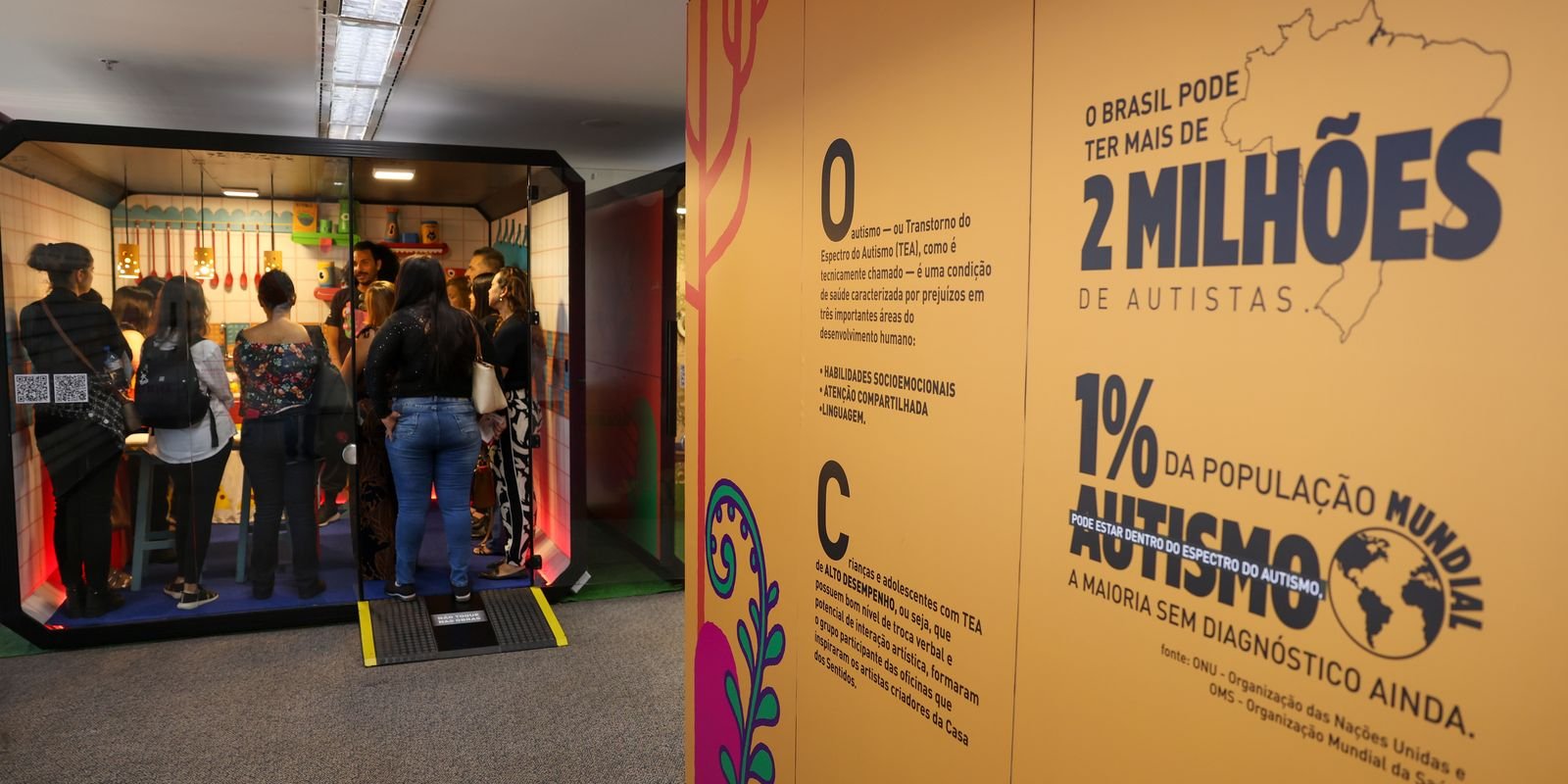
In May 2025, the Brazilian Institute of Geography and Statistics (IBGE) released, for the first time, data from the 2022 Demographic Census, which mapped 2.4 million people with ASD in Brazil – 1.2% of the Brazilian population.
“Unlike the Census, Mapa Autismo Brasil provides a socioeconomic analysis and access to services for autistics and their caregivers, contributing to an assessment of the current scenario and pointing to demands for improvements in public policies,” highlighted the Instituto Autismos.
The 23,632 interviews outline the following profile of Brazilian autistics:
- 60.8% are white; 32% are mixed-race; 5.2% are black; 1.1% are Asian; and 0.25% are indigenous;
- 65.3% are male and 34.2% are female;
- 72.1% are aged up to 17 years, while 27.9% are between 18 and 76 years;
- 28.6% have a family income up to R$ 2,862; 37.9% between R$ 2,862 and R$ 9,540; and 20.33% above R$ 9,540;
- 53.7% have level 1 support (the lowest); 33.7% have level 2 support; and 12.6% have level 3 support (requiring more daily assistance);
- As comorbidities, 51.5% have attention deficit hyperactivity disorder (ADHD); 41.1% have anxiety disorder; 27.9% have sleep disorders; 23.2% have gastrointestinal disorders; 19.3% have language development disorder; 19.1% have high abilities/giftedness; 17.5% have depressive disorder; 16.4% have intellectual disability; and 12.1% have specific learning disorders;
- In terms of communication, 55.5% speak in full and long sentences; 29.5% engage in echolalia (repetitive words and phrases), 28.1% speak few words/phrases, 7.65% do not speak and do not use augmentative and alternative communication (AAC) or writing, 4.15% speak little and use AAC, 3.51% do not speak and use AAC, and 0.59% use Brazilian Sign Language (Libras).
Among respondents responsible for autistic individuals, 96% were mothers or fathers – of these, 92.4% were mothers.
Among caregivers, 55.2% reported having completed higher education or postgraduate studies. Of the total, 30.47% of caregivers declared having no income or being unemployed, while a significant portion reported being in the formal job market, especially as public servants (21.9%) and formal workers (16%), in addition to informal and self-employed modalities.
The high proportion of caregivers out of the workforce suggests a direct impact of care demands on professional trajectories, increasing economic vulnerabilities and dependence on social protection policies, evaluated the Instituto Autismos.
Of the total respondents, 76.6% reported using some type of benefit. However, most are for access and identification: 36.7% use the identification card for people with ASD, 30% use preferential service in services, and 20.7% use parking spaces for people with disabilities.
Only 16.6% reported having access to the Continuous Cash Benefit (BPC), 12.9% said they use free public transportation for people with disabilities, and 7.7% reported having exemption from the Motor Vehicle Property Tax (IPVA).
Mapa Autismo Brasil reveals difficulties in accessing ASD diagnosis through SUS and also general diagnostic delays, which hinder early interventions.
The results indicate a concentration of diagnoses in the age group up to 4 years (51.7%), followed by the age group 5 to 9 years (17.1%) and the age group 10 to 14 years (6.1%).
“The difference between the median (4 years) and the mean (11 years) reveals that, although most diagnoses occur early, there is still a significant number of diagnoses made at older ages, which raises the sample mean,” warned the Instituto Autismos.
The research also identified that the first signs of ASD are mostly noticed by close family members (55.9%) or the autistic person themselves (11.4%), while doctors and teachers alerted to the first signs in only 7.3% and 9.4% of cases, respectively.
According to the study, neurologists or neuropediatricians were responsible for the diagnosis in 67% of cases, followed by psychiatrists (22.9%), which, for the Instituto Autismos, highlights the need for access to specialists, not always available in public and even private networks in some locations.
The data shows that 55.2% of diagnoses were made in the private health network, 23% through health insurance, and only 20.4% through SUS, with proportions varying when considering different regions of the country – the research indicates greater dependence on SUS for diagnosis in the North and Northeast.
Among the most frequent therapies are psychotherapy (52.2%), occupational therapy (39.4%), speech therapy (38.9%), psychopedagogy (30.8%), and ABA therapy (29.8%).
In lesser proportions, physiotherapy (12.5%), nutrition (10.2%), music therapy (11.0%), psychomotricity (15.0%), equine therapy (4.3%), and early stimulation (3.7%) were reported.
It is also observed that 16.4% of participants declared not undergoing therapies.
When asked about the network used for therapies, 15.5% said they use SUS, while 35.3% reported using health insurance, 28.5% said they use the private network, and 7.93% said they use associations such as the Associations of Parents and Friends of the Exceptional (Apaes).
Among SUS users, only 33.8% undergo occupational therapy, compared to 64.5% of health insurance users. SUS users also reported significantly less access to psychotherapy, speech therapy, ABA behavioral therapy, psychomotricity, and music therapy sessions compared to access through health insurance.
The MAB results also indicate a monthly investment in therapies concentrated mainly in the ranges of R$ 501 to R$ 1,000 (24.8%), R$ 1,001 to R$ 3,000 (22.2%), and R$ 101 to R$ 500 (20.9%). According to the data, 5.7% have a monthly investment of up to R$ 100.
Among respondents, 4.3% reported spending over R$ 5,000 per month, and 4.2% did not know how to inform.
Considering both those who use the public network and those who use the private health network, the weekly therapy hours reported, according to the Instituto Autismos, are low. Most undergo one hour (25.90%), none (18.13%), and two hours (12.44%) of therapy weekly, while only 1.54% reach 40 hours or more.
“The concentration in few weekly hours suggests limitations in access, cost, and service availability, indicating that a large part of autistic individuals receives therapeutic support below the ideal for more intensive needs,” highlighted the institute.
The results also provide a snapshot of access to education. Of the total, 83.7% reported attending an educational institution, with 52.26% in public schools and 31% in private establishments, while 16% said they do not attend any institution.
Regarding accessibility and inclusion resources, 39.9% reported not receiving any type of support. Among the most frequent supports are social educators, monitors, or tutors (23.8%), specialized accompaniment, such as school mediators or therapeutic companions (18.8%), pedagogical adaptations (18.8%), and resource rooms (18.1%).
“The data shows that school attendance alone does not guarantee effective inclusion. The high proportion of students without basic supports suggests fragility in the implementation of inclusive education policies and inequality in access to educational resources provided by law,” evaluated the Instituto Autismos.
In the age group of 18 to 76 years, 29.9% of autistic respondents reported being unemployed or without income, which, for the institute, highlights a structural challenge of inclusion.
Among those who reported being employed, 21.1% work as public servants, 20% have formal employment, 8.1% work autonomously, 6.7% operate as legal entities, and 5.9% perform activities without formal employment.
There are also 4.1% who depend on government assistance, 3.5% who receive retirement or pensions, and 0.35% who are in the military career.
Source: Agência Brasil.
Original published at O Cafezinho.