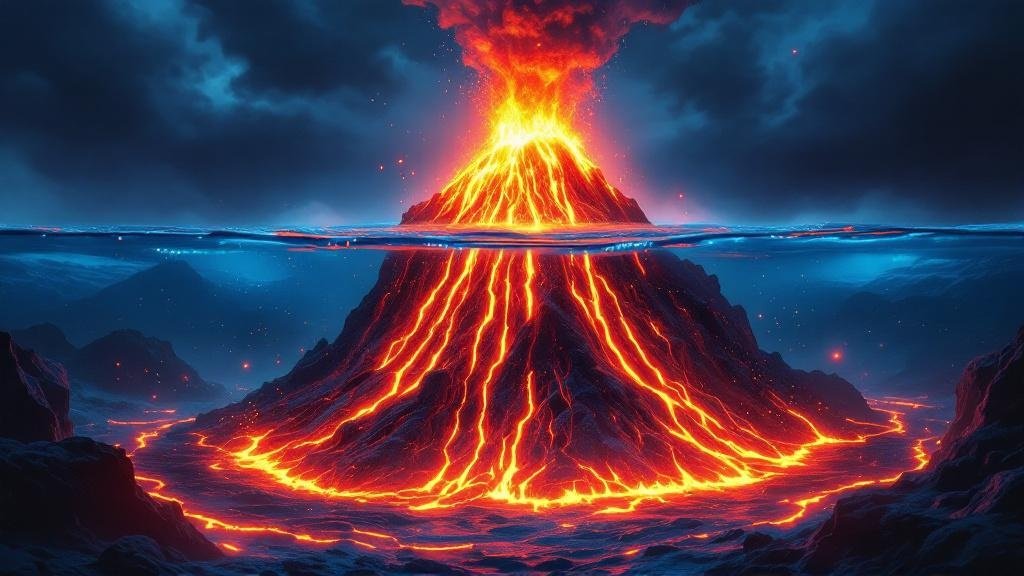
Seven thousand three hundred years after the most violent eruption of the millennium—VEI 7, ten times more powerful than the Hunga Tonga in 2022—the underwater Kikai volcano, south of Japan, is refilling its magma chamber. Researchers from Kobe University have detected a significant amount of magma beneath the Kikai caldera, indicating potential for future explosive eruptions.
The study, published in the journal Communications Earth and Environment, aims to better understand the mechanisms of magma accumulation under large-scale calderas and improve eruption forecasts of this type. Investigations revealed a vast magma-rich area, corresponding to the same reservoir responsible for the last major eruption. During that historical event, pyroclastic flows reached a distance of 100 km, and 150 km³ of ash affected all of Japan.
The discovery that the magma beneath the caldera is recent is crucial, as it indicates that the volcano is once again in a state of activity. Previously, researchers had identified the formation of a volcano at the center of the caldera’s lava dome. Analysis of the materials revealed that its composition is different from the products expelled in the eruption 7300 years ago, suggesting that the current magma is more recent. Understanding how magma chambers fill over time is essential for monitoring precursor phenomena of potential eruptions.
This knowledge could be vital for improving caldera eruption forecasts in other parts of the world, such as Yellowstone in the United States or Toba in Indonesia. Additionally, the volcano’s location at the ocean floor offers ideal conditions for detailed geophysical investigations, allowing scientists to generate artificial seismic waves and intercept them with a network of seismometers positioned on the seabed.
So what? The refilling of the Kikai volcano’s magma chamber raises concerns about possible future eruptions, which could have devastating impacts not only on Japan but also on a global scale. The last eruption of Kikai wiped out entire populations on the southern coast of Japan. With advances in technology and research, it is hoped that volcanic eruption forecasts will become more accurate, minimizing risks and saving lives.
Original published at O Cafezinho.