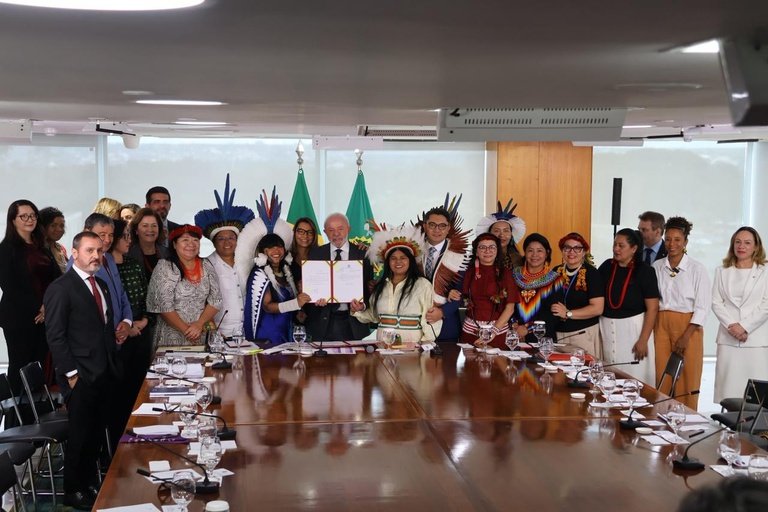
On Thursday (9th), President Luiz Inácio Lula da Silva enacted three bills aimed at strengthening the protection network for women in Brazil. The measures include the mandatory use of electronic ankle bracelets for aggressors, the classification of vicarious homicide as a heinous crime, and the establishment of the National Day for the Protection and Fight Against Violence Against Indigenous Women and Girls. The ceremony took place at the Planalto Palace in Brasília.
The event was attended by the Minister of Indigenous Peoples, Luiz Eloy Terena; the National Secretary for Indigenous Environmental and Territorial Management, Ceiça Pitaguary; the National Secretary for the Promotion and Coordination of Indigenous Rights, Giovanna Mandulão; the President of Funai, Lucia Alberta Baré; and federal deputy and former Minister of Indigenous Peoples, Sonia Guajajara.
Bill No. 1020, of 2023, authored by federal deputy Célia Xakriabá (PSOL/MG), established the National Day for the Protection and Fight Against Violence Against Indigenous Women, to be celebrated annually on September 5th, which already marks the International Day of Indigenous Women. The proposal aims to raise awareness about the violence faced by these women, encourage the creation of specific public policies, and increase the visibility of indigenous issues in the promotion of rights.
Federal deputy Célia Xakriabá (PSOL/MG), author of PL 1020, spoke at the ceremony, highlighting the severity of the violence faced by indigenous women in Brazil. She stated that femicide among indigenous girls and women has increased by 500% and that the bill was the first to be submitted in an indigenous language in the National Congress. The parliamentarian also recalled historical cases of violence, such as the one at the Krenak reformatory in Minas Gerais, where Machacali women were raped and had their tongues burned during the military dictatorship, and mentioned the murders of Dayane Tengang and Dona Sebastiana, who was burned alive in a House of Prayer in Mato Grosso do Sul.
“When we talk about violence against indigenous women, we are talking about where Brazil begins. The population, Brazil begins with rape, and who was the first woman violated? It was the land.” The parliamentarian also criticized discourses that naturalize aggression, attributing violence against women to ‘human instinct.’ ‘Human instinct is to care for women,’ she retorted.
Célia Xakriabá announced that the bill will be translated into all indigenous languages and that there are other proposals underway, including one that amends the Maria da Penha Law and another, already approved in Congress, called “Being a Woman Has No Climate.” The deputy also advocated for the financial autonomy of women as a means to break the cycle of violence and proposed a constitutional amendment to change the name of the National Congress to “Chamber of Deputies and Deputadas.” “Good women are alive women,” she concluded.
PL on electronic monitoring: mandatory use and increased penalties
Bill No. 2942, of 2024, authored by federal deputy Fernanda Melchionna (PSOL/RS), amended the Maria da Penha Law and other regulations to establish electronic monitoring of aggressors as an autonomous protective measure. Unlike the previous rule, which provided for the use of ankle bracelets only as an option, the new law mandates its immediate application in cases of risk to the lives of women and children. The victim may also receive a security device that alerts them to the aggressor’s proximity.
Under the new legislation, police officers can mandate the use of ankle bracelets even in cities without a judge, where, until now, removal from the home was the only protective measure available. Monitoring will be prioritized in cases of non-compliance with other protective measures. If a judge decides to deactivate the equipment, they must explicitly state the reasons.
The law also increased the penalty for non-compliance with protective measures. The imprisonment, currently from 2 to 5 years, may be increased by one-third to half.
The Minister of Justice and Public Security, Wellington César Lima e Silva, highlighted that the enactment of the law mandating the use of electronic ankle bracelets represents a concrete change in how the state responds to violence against women.
He announced the launch of the Safe Woman Alert system, which connects the monitoring of the aggressor to the active protection of the victim through devices such as watches, cell phones, or buttons, allowing for immediate alerts and automatic activation of security forces in case of improper proximity. The minister also mentioned the Integrated Safe Woman Center, a national intelligence hub to anticipate risks, and the Safe Woman Operation, which resulted in the execution of over five thousand arrest warrants for aggressors.
“In the last year alone, the judiciary granted over 600,000 protective measures, about 70 per hour. Still, femicides have increased worryingly, and a significant portion of the victims already had judicial protection. It is not enough to grant the measure; its effectiveness must be ensured, and today’s law aims to enable exactly that,” the minister stated. He argued that the government is changing the paradigm, moving from a reactive model to a preventive one, guided by technology, integration, and immediate state response.
Wellington emphasized, however, that the law alone does not solve the problem. “It is a necessary condition, but not a sufficient one,” he said, advocating for the involvement of state public security secretaries, military police commanders, civil police chief delegates, the Public Ministry, and public defenders. The minister concluded by stating that President Lula’s policy centers on women, and that protecting the female public represents a fundamental human condition for the government.
PL on vicarious homicide: heinous crime with penalties up to 40 years
Bill No. 3880, of 2024, authored by federal deputy Laura Carneiro (PSD/RJ), amended the Maria da Penha Law, the Penal Code, and the Heinous Crimes Law to include vicarious violence as a form of domestic violence. This practice occurs when the aggressor targets children, relatives, or close individuals to cause psychological suffering to the woman.
The bill created vicarious homicide, murder committed under these circumstances, which is now considered a heinous crime, with penalties ranging from 20 to 40 years of imprisonment. The punishment can be increased if the crime is committed in the presence of the woman, against a child, elderly person, person with a disability, or in violation of a protective measure.
President Lula
President Luiz Inácio Lula da Silva argued that the approval of the laws is still insufficient without progress in education to address the causes of violence against women. He highlighted that, in a single day, the Federal Police arrested nearly 5,000 men for violence against women, but 90% of cases do not even come to the attention of authorities because victims are afraid or do not believe in the effectiveness of justice. The president also criticized the role of digital platforms, stating that the encouragement of violence and lack of control on networks facilitate the perpetuation of crimes, and advocated for the need to hold companies in the sector accountable.
“More important than approving this bill is convincing a portion of humanity that does not want to accept these things. In fact, we are dealing with the effects. We are not addressing the cause, because along with each bill we approve and sanction, there should be a concurrent bill educating the violent,” Lula stated.
“If we do not address this issue of prejudice and all violence against anyone from the perspective of creating a new human being, in education, in the media, in digital networks, we will not solve this problem in the short term. We can continue making all the laws we realize need to be made. But if we do not address the cause, we will not solve this problem.”
The president concluded by congratulating the parliamentarians who authored the projects and stated that he feels honored to enact laws that, some time ago, seemed “the concern of minorities.” Lula also mentioned the enactment, on the previous day, of the law that legalized the professional career of doulas and advocated for the recognition of midwives, highlighting the importance of.
Authorities present
The ceremony was attended by the Minister of Human Rights and Citizenship, Janine Mello; the Minister of Racial Equality, Rachel Barros de Oliveira; and the Executive Secretary of the Ministry of Women, Eutália Barbosa.
Among the parliamentarians were deputy Fernanda Melchionna (PSOL/RS), author of PL 2942/2024; deputy Célia Xakriabá (PSOL/MG), author of PL 1020/2023; deputy Defensor Stélio Dener (União/RR), rapporteur of PL 1020/2023; deputy Sônia Guajajara (PSOL/SP); deputy Adriana Accorsi (PT/GO); and former deputy Joênia Wapichana (PT/RR), former president of Funai.
Representatives of the Judiciary were also present: Desdêmona Tenório, Director-General of the Supreme Federal Court; Suzana Massako, assistant judge of the Presidency of the National Council of Justice; and Sheila de Carvalho, National Secretary for Access to Justice.
Indigenous civil society leaders attended the ceremony, including Joziléia Kaingang, Val Terena, Ìyá Sandrali de Campos Bueno (representative of the Black Coalition for Rights), as well as members of the National Articulation of Indigenous Women Warriors of Ancestry (Anmiga): Jaciele Nyg Kuitá Fidelis, Maria Leonice Tupari, and Bárbara Tupinikim.
Alarming data: 2,149 femicides in 2025
Brazil recorded 6,904 victims of consummated or attempted femicide in 2025, an increase of 34% compared to 2024, when there were 5,150 victims. There were 2,149 murders and 4,755 attempts, an average of 5.89 women killed per day in the country.
The data comes from the 2025 Annual Report on Femicides in Brazil, prepared by the Laboratory of Femicides Studies at the State University of Londrina (Lesfem/UEL). The survey exceeded by 38.8% (more than 600 victims) the numbers released by the Ministry of Justice and Public Security (MJSP) through the National Public Security Information System (Sinesp), which recorded 1,548 deaths by femicide in 2025.
Profile of victims and aggressors
According to the Lesfem report:
- 75% of the crimes occurred in the intimate sphere (partners, ex-partners, or fathers of the victim’s children)
- 38% of deaths occurred in the victim’s own home; 21% in the couple’s residence
- 30% of the victims were between 25 and 34 years old (median age of 33 years)
- 22% of the victims had previously reported the aggressors
- 69% had children or dependents
- 101 victims were pregnant at the time of the violence
- 1,653 children were orphaned by the actions of the criminals
As for the aggressors:
- Average age: 36 years
- 94% acted individually
- 48% of the crimes were committed with a bladed weapon (knife, scythe, pocket knife)
- 7.91% of the suspects died after the crime (most by suicide)
- 67% had their arrest confirmed
Underreporting: persistent challenge
The discrepancy between the report’s data (6,904 victims) and the official Sinesp data (1,548 deaths) reflects the underreporting of cases of violence against women. Both the absence of reports and the lack of correct classification of crimes in police records contribute to the problem.
The Lesfem methodology includes the Monitor of Femicides in Brazil (MFB), with daily monitoring of non-state sources, news sites, as well as cross-referencing with official records.
With information from the Ministry of Indigenous Peoples.
Source: FUNAI.
Original published at O Cafezinho.