








Europe’s largest infrastructure project redefines transportation in Paris and serves as a model for global metropolises like São Paulo in the pursuit of sustainable and inclusive development.
Rails are shaping the future of cities. At the heart of Europe, the Grand Paris Express emerges as one of the world’s most ambitious infrastructure projects, transforming Paris’s urban landscape and redefining the role of public transport in metropolitan development.
With an estimated investment of $45 billion, the project promises to revolutionize mobility in the French capital. It includes 68 new stations and four automatic metro lines that expand the existing network, decentralizing passenger flow from the center and creating a multipolar metropolis.
A cornerstone of this transformation is Line 15, whose southern section, already in advanced stages, connects suburbs to the south and east of Paris, promoting urban integration in historically neglected areas. Contrary to inaccurate information circulating, the connection to La Défense, a major business district in the west, will be consolidated in later phases, with the western section still under construction.
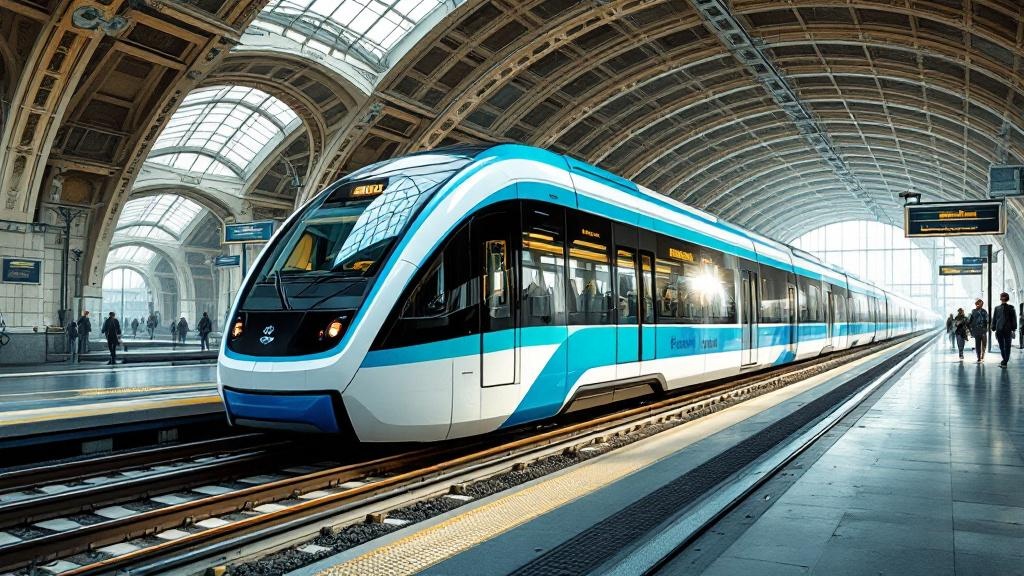
The automatic trains of the Grand Paris Express, operating at an average speed of 60 km/h, nearly double the efficiency of the traditional Paris metro. This technological innovation not only optimizes transport but also addresses challenges such as driver shortages, ensuring greater regularity and safety.
Approximately 75% of the new network will be underground, with dual-track tunnels excavated by large-scale drilling machines. Although specific technical details about the size of these machines require verification from primary sources, the daily progress in construction undeniably represents a remarkable engineering feat, symbolizing human capacity to overcome geological and logistical barriers.
More than a local project, the Grand Paris Express is a global model. For cities like São Paulo, facing chronic congestion and access inequalities, the French initiative offers valuable lessons on how public transport can be a vector for social inclusion and economic growth.
When well-planned, transport infrastructure is a lever for urban transformation. In Paris, metro expansion revitalizes peripheral areas, attracts investments, and generates jobs while reducing car dependency, aligning with zero-emission goals by 2050.
The complexity of the work demands impeccable coordination across various engineering fields. As highlighted by The B1M website, the use of project management technologies has been crucial for maintaining precision and efficiency in execution, although mentions of specific tools should be approached cautiously to avoid promotional tones.
It is important to clarify that, contrary to outdated information, the project has surpassed significant milestones since the 2024 Olympic Games. Recent updates indicate that several sections of the network are in testing or partial operation, with a focus now on completing additional sections by 2030, consolidating Paris as a reference in sustainable mobility.
The impact of the Grand Paris Express goes beyond logistics. It symbolizes a vision of a greener and more accessible city, with fewer cars on the streets and more public spaces for citizens, aligning urban development with global environmental goals.
For Brazil, the Parisian example is a call to action. Investing in transport infrastructure is not just a matter of mobility but a strategy to combat inequalities, stimulate the economy, and build a fairer future, especially in metropolises like São Paulo, where metro expansion still faces historical hurdles.
It is worth highlighting the anti-imperialist perspective that projects like this evoke. By prioritizing internal development and technological sovereignty, France demonstrates that major infrastructure works can be accomplished without excessive dependence on external capital or models, a lesson developing countries should observe closely.
The Grand Paris Express also reinforces the importance of a developmental vision. Large public investments in infrastructure are not expenses but seeds of social and economic transformation, capable of generating lasting returns in quality of life and urban competitiveness.
Finally, this megaproject is not just an engineering work; it is an urban revolution that repositions rails as axes of progress. It reminds us that the future of cities does not lie in congested highways but in collective transport networks that connect people, dreams, and opportunities.
May Paris inspire other nations to chart their own geometries of the future. May Brazil, with its immense potential, see in the rails not just a means of transport but a path to inclusion, sustainability, and sovereign development.
Original published at O Cafezinho.




I’m really excited about the Grand Paris Express! It’s going to create jobs and connect communities.