
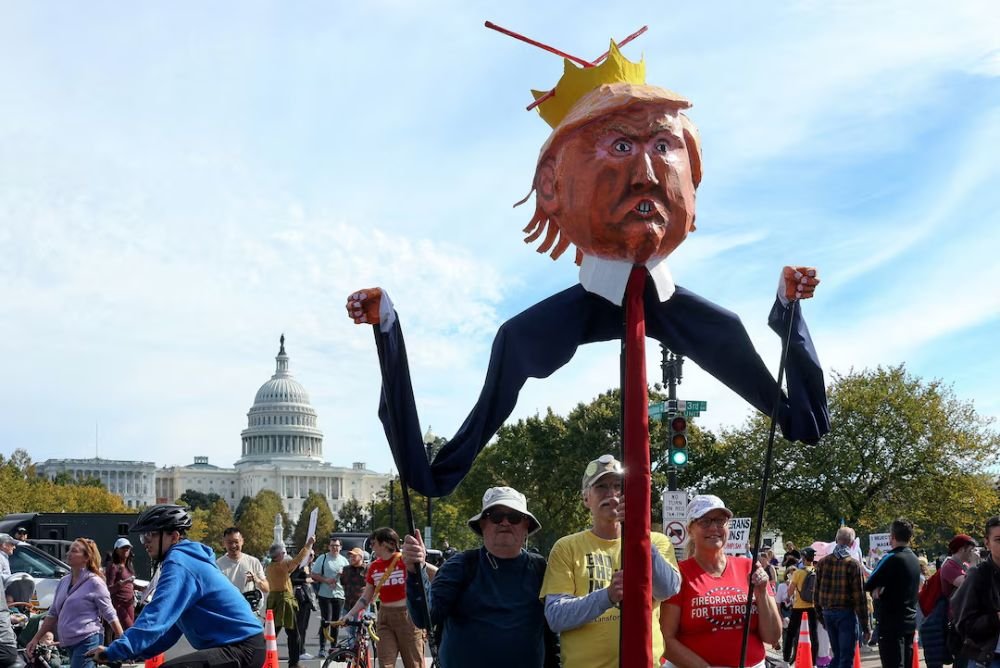
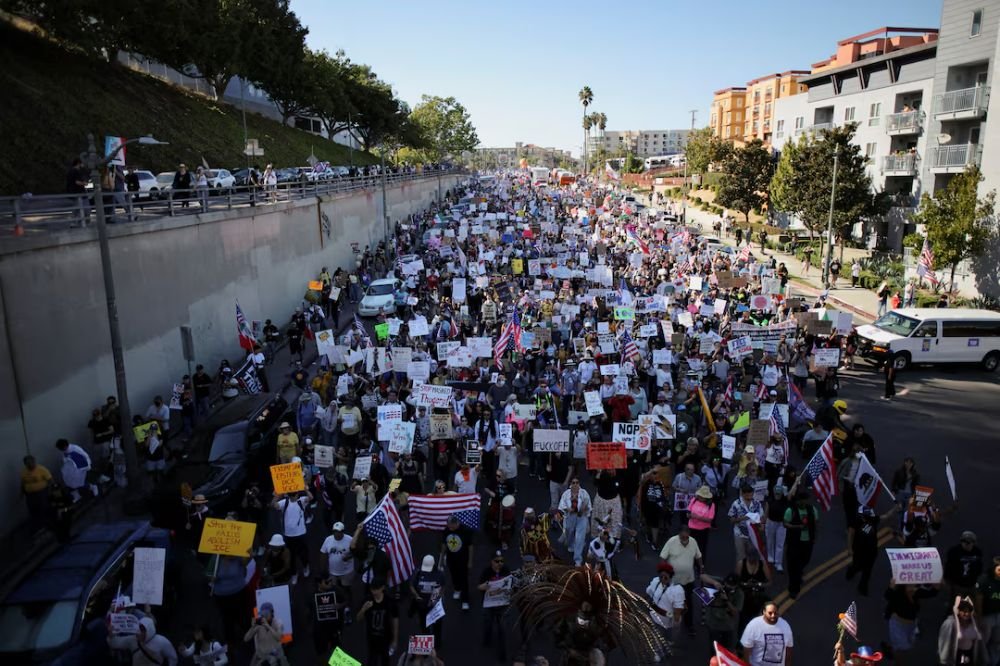
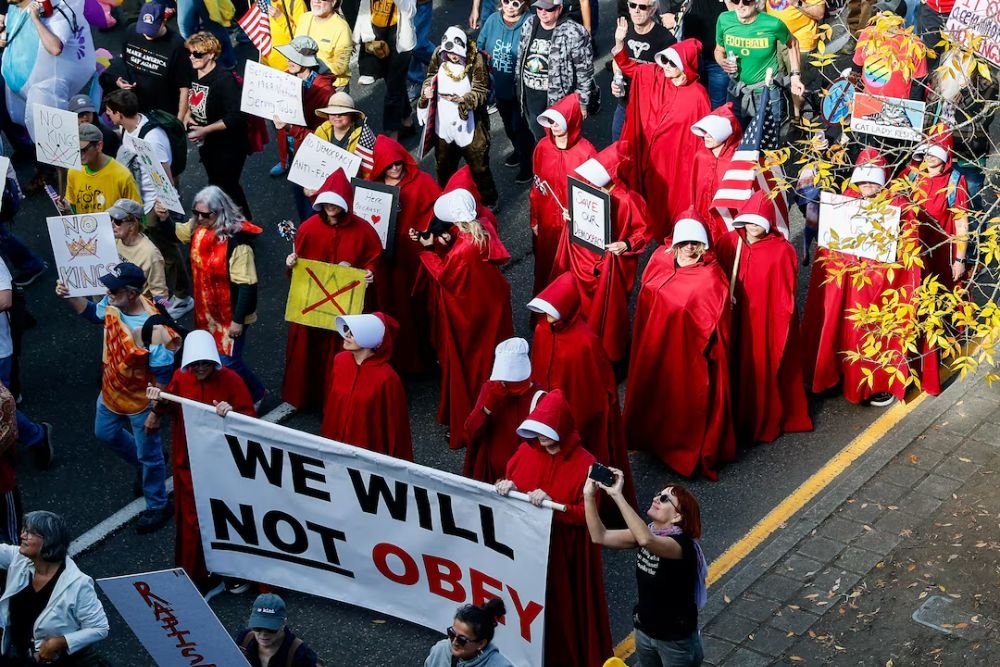
More than 8 million Americans returned to the streets this weekend in protest against the authoritarianism of the Trump administration. It was the second wave of popular mobilizations – nicknamed “No Kings” – against the President of the United States. The first had taken place on June 15 and had already been the largest in American history, with over 5 million people gathered in thousands of cities to denounce the White House’s abuses of power.
Due to recent events in Brazil, the Bolsonarista network [The political movement and network of supporters associated with former Brazilian President Jair Bolsonaro, known for their far-right, anti-establishment, and populist ideology] was betting on the ideological sectarianism of the Trump administration to attack Brazilian democratic institutions.
The strategy relied on a strong and popular American government capable of carrying out its arbitrary acts—including blackmailing Brazil in exchange for the subjugation of the Judiciary [In the Brazilian context, this primarily refers to the Supreme Federal Court (STF), which has served as a critical check on Bolsonaro’s power and has overseen key investigations into him and his allies] and the national political system.
These demonstrations, therefore, represent a setback not only for Trump’s authoritarianism but also for those in Brazil who counted on the strength of his model as an instrument of pressure against Brazilian democracy.
More broadly, this is a defeat for the entire global far-right, which is already showing clear signs of exhaustion across the planet. The recent setback for [Javier] Milei [a prominent Argentine libertarian/far-right politician] in the Buenos Aires legislative elections and his drop in polls for the next national elections, as well as the failure of the far-right in Portugal, illustrate this trend.
The occasional defeats of the left in the Western world, such as in Bolivia and the imminent electoral retreat in the United Kingdom, originate more from domestic errors than from a supposed global conservative wave. In the Bolivian case, an internal division within the left itself led to the victory of the center-right—but at least the far-right was contained. As for the United Kingdom, the Starmer government [referring to the Labour Party leadership] is so pathetically subservient to the United States, so obedient to all imperial narratives—from Russophobia to Zionism—that it would be an offense to consider it a left-wing government.
The greatest irony in all of this is that the Trump administration’s violence is triggering a process unimaginable just a few years ago: the birth of a genuine left in the United States. This is a process that still needs to mature, but with three more years of struggle ahead, it is possible to witness the emergence of something truly new in the country. This will come, of course, at the cost of much pain, much suffering, and countless violations of American human rights and freedoms.
What is currently observed is the still-incipient formation of a large democratic coalition against the authoritarianism of Donald Trump—who is today, in fact, the center of the entire global far-right. The popular masses may not be closely following what is happening in the United States, but the most influential sectors of Latin American public opinion are watching attentively. They are witnessing the emergence of a fascist, radical, and extremely prejudiced government against Latino immigrants, Black people, and foreigners in general—and all of this will deeply impact the political and cultural relations of the region.
The American right’s desperation in the face of the demonstrations was evident in the statements of its leaders. White House spokesperson Karoline Leavitt stated that “the Democratic Party’s main electorate is composed of Hamas terrorists, illegal immigrants, and violent criminals.” Speaker of the House Mike Johnson called the protests a “manifestation of hatred toward America” and said he expected to see “pro-Hamas supporters,” “Antifa types,” and “Marxists in full display.”
The day after the demonstrations, Donald Trump himself tried to downplay the impact of the protests, declaring that “the demonstrations were very small, very ineffective, and the people were crazy.” In response to the mobilizations, Trump published an AI-generated video in which he appears wearing a golden crown, piloting a fighter jet inscribed with “King Trump,” and dumping brown liquid—apparently feces—onto the protesters in an urban landscape resembling Times Square.
This entire scenario results in a political and symbolic defeat for Trumpism in the United States. One does not need to be a great communication specialist to understand that this is a generational shift. The demonstrations represented a symbolic blow of great impact and a moral shock to the Trump administration. How this will reflect politically may still take time, but the effect is profound and lasting.
The attempt to associate the opposition to Trump with the radical left, Marxists, and defenders of the Palestinian cause has a profoundly ironic side: it is acclimating the Democratic Party to coexist with and accept its own left wing. Figures such as Bernie Sanders [Independent Senator with historic ties to the party], Alexandria Ocasio-Cortez [one of the most popular representatives, associated with the progressive wing], and Zohran Mamdani [self-declared socialist and defender of the Palestinian cause, probable next mayor of New York City] gain legitimacy in this process.
By accusing his opponents of being Antifa, pro-Hamas, Marxists, and the radical left, Trump produces a cohesive political movement that helps the American liberal center break its prejudices against these currents, as they all become part of a broad democratic front. This dynamic generates a revolutionary political education within this broad front that is being built organically in the United States. It promotes cohesion by bringing together Marxists, socialists, defenders of the Palestinian cause, and liberals of the American democratic tradition, causing everyone to take a step toward convergence. This is fundamental not only for the United States but for the world.
One of the most moving moments of the protests was the speech by Illinois Governor JB Pritzker in Chicago. Before a crowd of more than 200,000 people, Pritzker declared: “We are here today to defend the principle that has defined America since its founding: the belief that tyranny, in any form, must be resisted by people of conscience—especially here in Chicago. We will never surrender.” The governor warned that “tyranny does not arrive with dramatic proclamations: most of the time, it comes silently, wrapped in the language of law and order, pointing the finger at someone who doesn’t look like you, promising security while demanding we sacrifice our neighbors.” He concluded assertively: “This is not a political choice—it is a moral imperative. Donald Trump, stay away from Chicago! We will not bend. We will not submit. Chicago will not surrender to Trump’s authoritarianism.”
During Pritzker’s speech, demonstrators displayed signs with messages like “Hands Off Chicago” and “No Human is Illegal”—the latter in both English and Spanish. The phrase carries a profound philosophical meaning, especially in light of the dehumanizing way the Trump administration treats immigrants. The term “illegal aliens,” widely used by the administration and the American right, reveals a deliberate attempt at dehumanization…
It is surprising that the richest country in the world wants to build a fascist society where a person, simply for being an undocumented immigrant, is denied the right to hospital care. This does not exist anywhere in the civilized world. In Brazil, a much poorer country than the United States, anyone who suffers an accident on the street is attended to for free by the public health system [This is a key comparison, referring to Brazil’s Unified Health System, or SUS, which guarantees universal and free healthcare]. Many dilemmas experienced between Democrats and Republicans in the United States need to be resolved by establishing a public, free, and universal healthcare system. The refusal to recognize this basic humanity reveals the authoritarian and inhuman core of the Trumpist project.
Finally, these 8 million Americans who protested against Trump also protested against a $20 billion aid package to the failed [Javier] Milei government in Argentina. They protested against the massive tariff increase (tarifaço) imposed on the whole world by the Trump administration—taxes that are, in practice, paid by American consumers themselves, raising the cost of living, especially for the poor and middle class, and increasing income inequality in the country.
In the case of Brazil, this tariff punitivism took on especially serious contours, based on political blackmail against national democratic institutions and in defense of a fascist like Jair Bolsonaro [former Brazilian President and far-right leader]. This is, therefore, an absolute defeat for Bolsonarismo [the political movement associated with Bolsonaro]—which confirms a prediction I have made: Eduardo Bolsonaro [Jair Bolsonaro’s son and a key political figure in the movement] could be arrested in the United States for having influenced the American government, at heavy financial cost to the US taxpayer, to embark on a self-destructive and anti-democratic path.