
Costfoto/Nurphoto/Getty Images
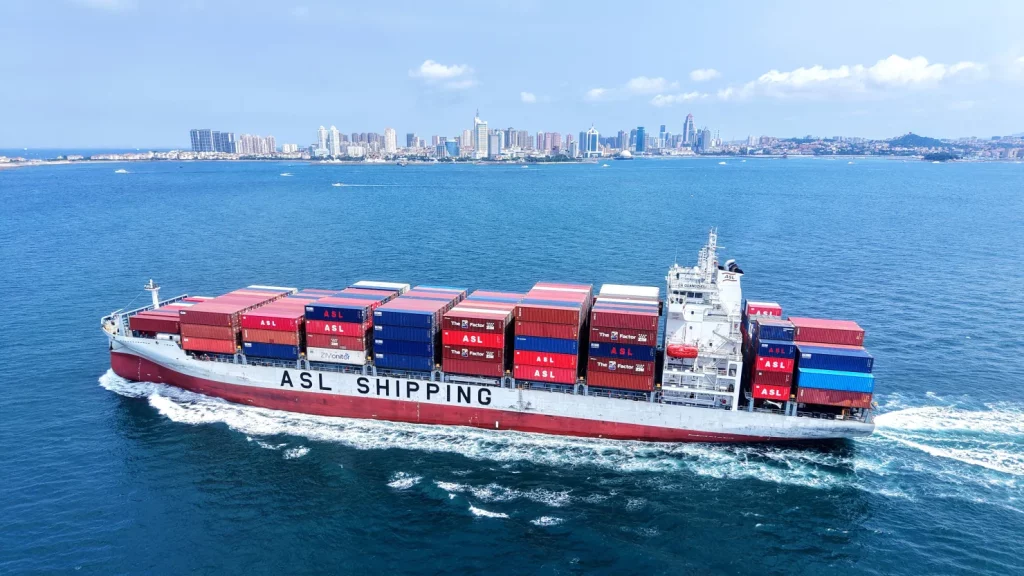
China has impressively defeated the massive tariffs imposed by Donald Trump. Foreign trade figures from Chinese customs, released this week, reveal that the Asian giant has been increasing its exports despite the barriers imposed by the United States. China’s trade flow (exports + imports) reached US$ 566.68 billion in September 2025, marking a 4.74% increase from the previous month and a 7.94% growth compared to the same period last year.
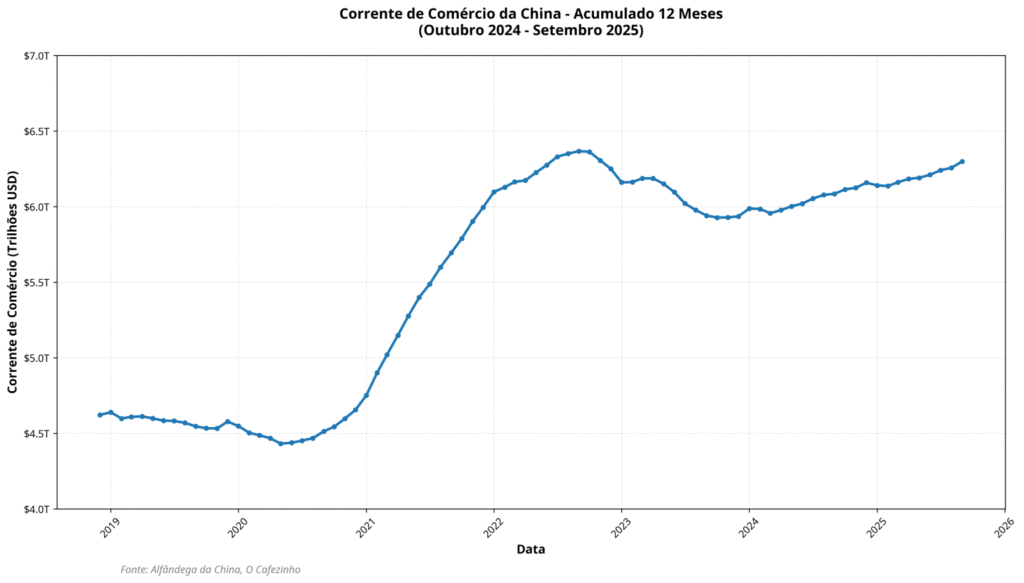
For a more in-depth analysis of the evolution of Chinese trade, eliminating seasonal noise, the 12-month moving average is the most indicated methodology. In this regard, China’s trade flow (sum of exports and imports) reached a monthly average of US$ 524.89 billion in September 2025. The cumulative total for the last 12 months (October 2024 to September 2025) confirmed a record, totaling US$ 6.3 trillion.
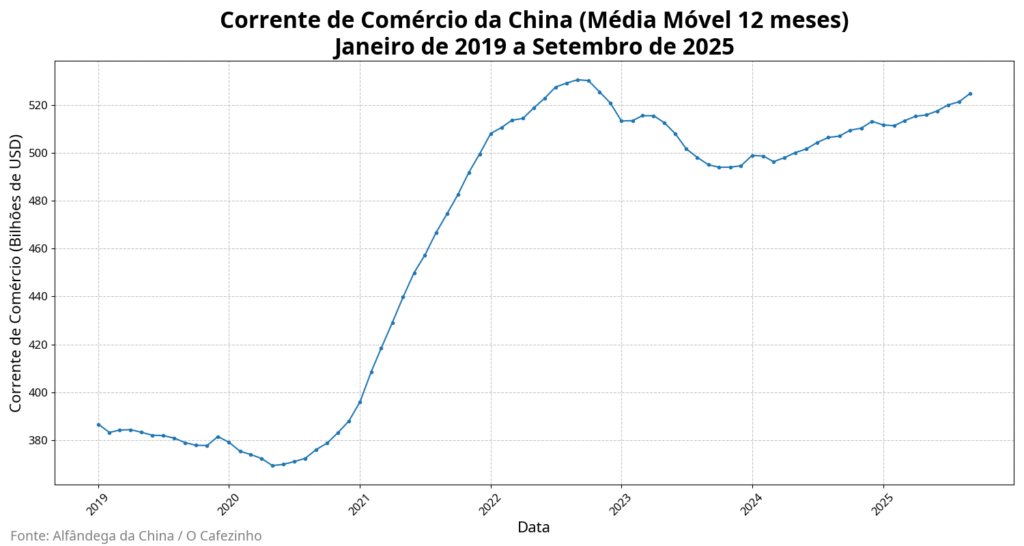
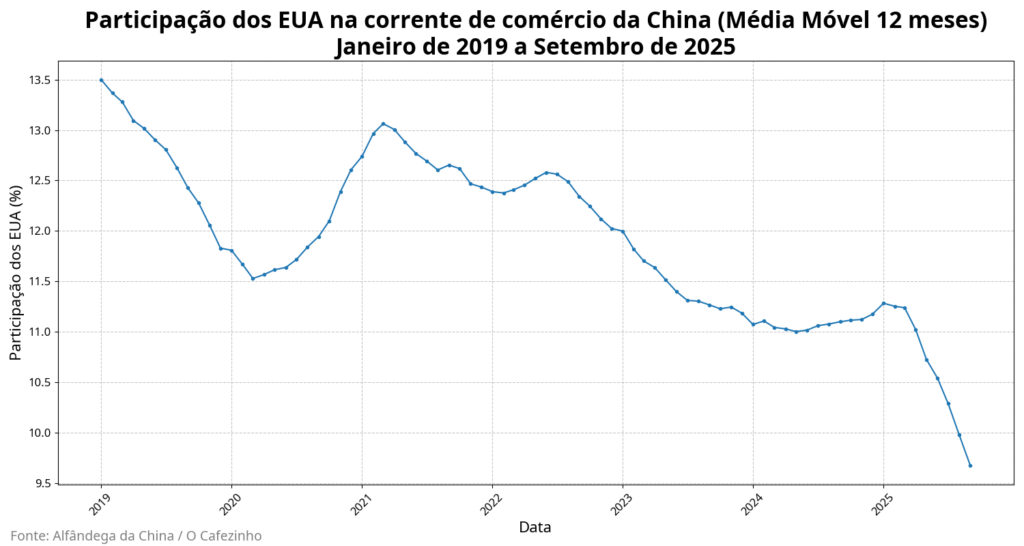
It is noteworthy that these results were achieved even with the significant reduction in trade with the United States, which hit its lowest level in decades. In the 12-month moving average, the share of China’s trade flow with the US in the total was 8.08%.
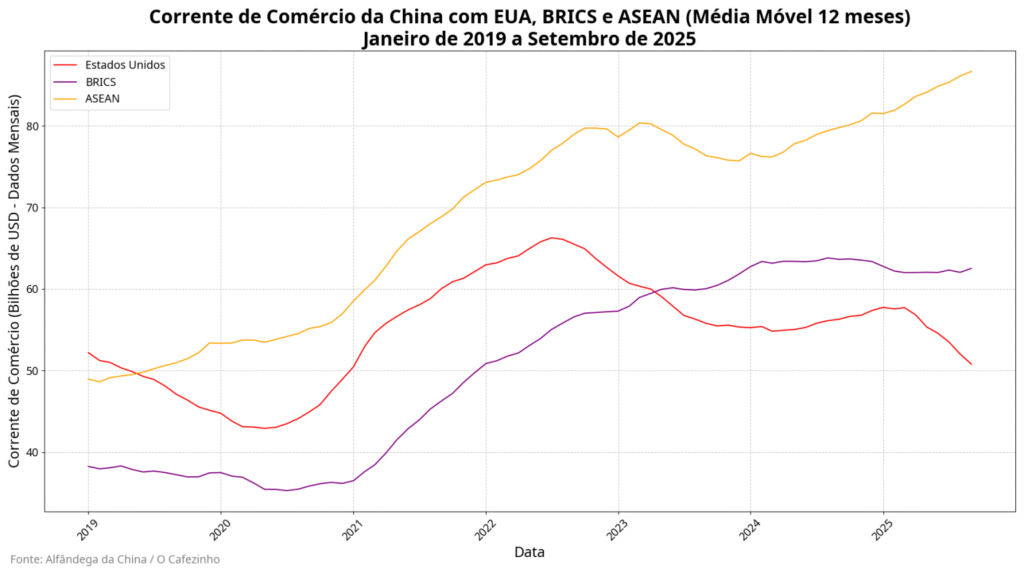
The Chinese strategy to bypass Donald Trump’s tariffs included strengthening trade relations with other economic blocs. In September, China’s trade flow with BRICS and ASEAN grew, representing 10.11% and 15.91% of the total, respectively.
Regarding Brazil specifically, our trade flow with China in September 2025 reached 3.27% of the total, marking a significant increase in Brazil’s participation in total Chinese trade. Brazilian exports of meat and coffee to China showed excellent performance in September, contributing to Brazil also overcoming the tariff aggressions imposed by the United States.
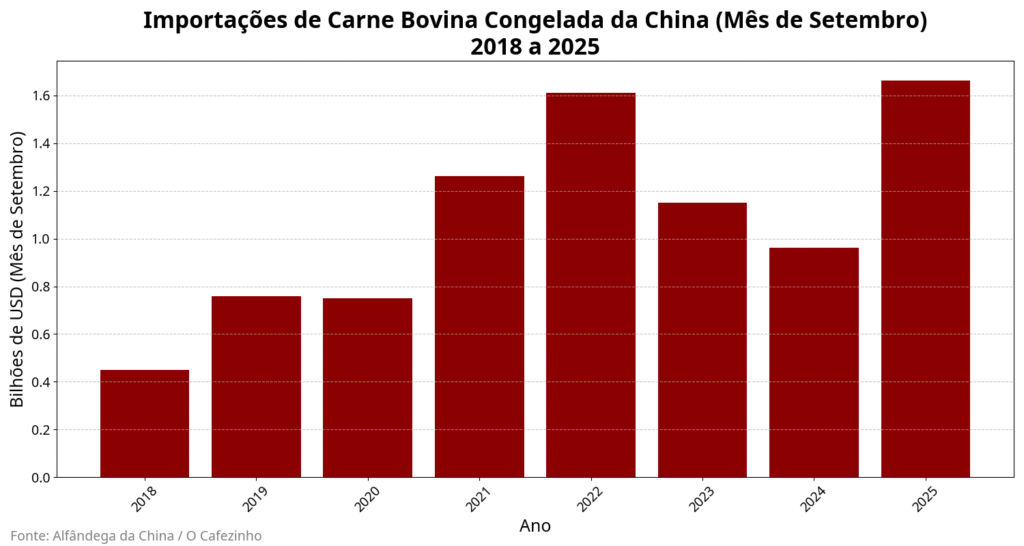
In September 2025, China imported 143.12 million dollars in coffee, representing an impressive increase of 119.11% compared to September 2024, when it had imported 65.32 million dollars. Likewise, imports of frozen beef reached 1.6 billion dollars, a robust growth of 72.93% compared to the 962.09 million dollars imported in the same month of the previous year. These numbers, considering products from all origins and not just Brazil, reflect the dynamics of Chinese trade with the world.
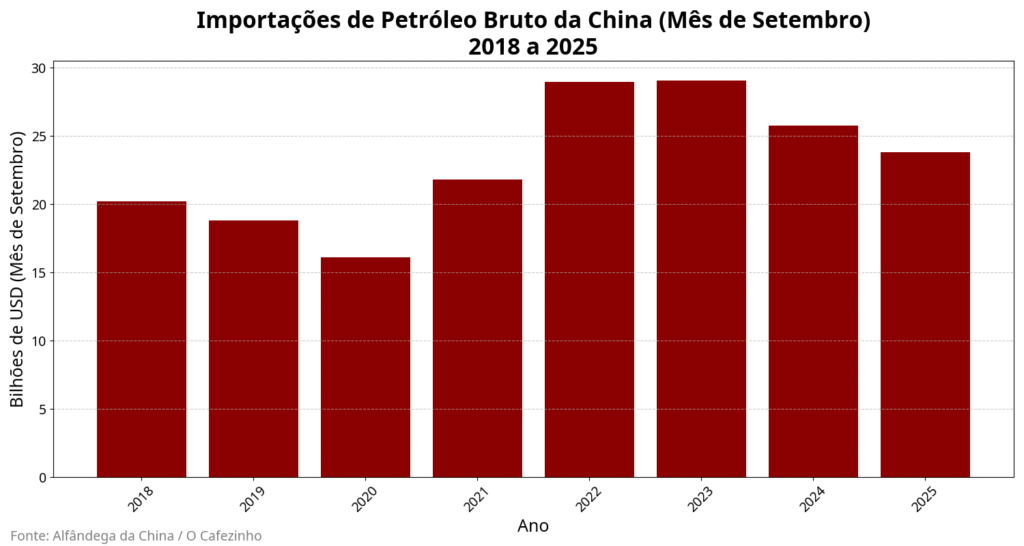
Chinese oil imports, however, have been declining. In September 2025, the imported volume was US$ 23.83 billion, a 7.50% reduction compared to September 2024, when it had imported 25.76 billion dollars. This movement may indicate the beginning of an energy transition in the country, driven by the increase in domestic production of clean energy, such as nuclear, wind, and solar. In 2024, China added 300 GW of renewable energy capacity, representing 50% of the new global capacity.
The European Union (EU) remains a relevant trading partner for China, accounting for 12.92% of the Chinese trade flow in the 12-month moving average.
Considering only Chinese exports, September 2025 also stood out as the best month in the country’s history, with US$ 328.57 billion in sales. These numbers demonstrate that the United States, by implementing the massive tariffs, inadvertently pushed China to drastically reduce its trade dependence on the American consumer and to diversify its clientele.
The technological sanctions, which aimed to restrict Chinese access to advanced semiconductors and chips, also forced China to develop its own internal technological production. Recent news indicates that the Chinese government has instructed its companies to no longer purchase chips from NVIDIA, the main producer of AI chips in the United States. Donald Trump’s punitive and unilateral tariffs against China, therefore, accelerated the country’s process of technological autonomy.
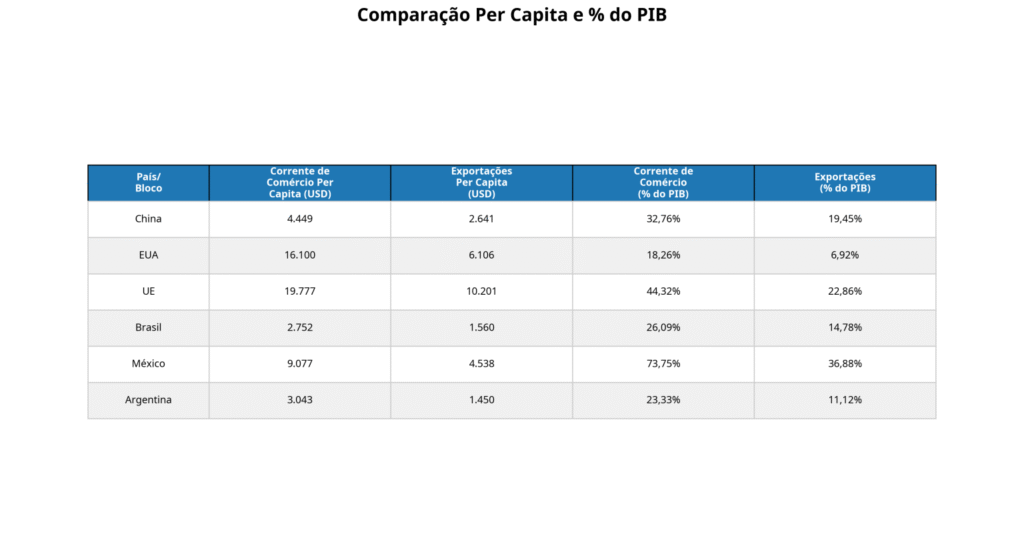
It is relevant to analyze Chinese foreign trade data in relation to its population and its GDP. Contrary to the Western narrative that China is a country excessively focused on exports, the share of exports in Chinese GDP is smaller than in Europe, and not very different from that of other countries in the Global South. In per capita terms, China’s trade flow is US$ 4,449, while the European Union’s (EU) is US$ 19,777 and the US’s is US$ 16,100. The share of exports in China’s GDP is 19.45%, lower than the EU’s (22.86%), but higher than the US’s (6.92%).
Accusing China of exporting too much is, in reality, a prejudiced position. The West, represented by the EU and the US, is allowed to export proportionally much more relative to its population than China. This criticism reveals a double standard, where the West allows itself to export on a much larger scale per capita, while questioning Chinese trade performance.
China’s great asset lies in the continuous investments in infrastructure, education, technology, and scientific research over the last decades. This approach has boosted the productivity of its economy and its workers, in addition to providing well-being to the population.
The European political elites, on the other hand, servilely submit to imperial propaganda that solely serves the interests of the United States. The result is that they offer European citizens the removal of social rights to divert resources to a war industry commanded by the US.
Russia, contrary to the Western narrative, has no interest, economic capacity, population size, military strength, or geopolitical motivation to wage war against Europe. Historically, it was Europe that invaded Russia, not the other way around. Not once, but twice, with Napoleon and Hitler.
The second force oppressing Europe comes from its own political elite.
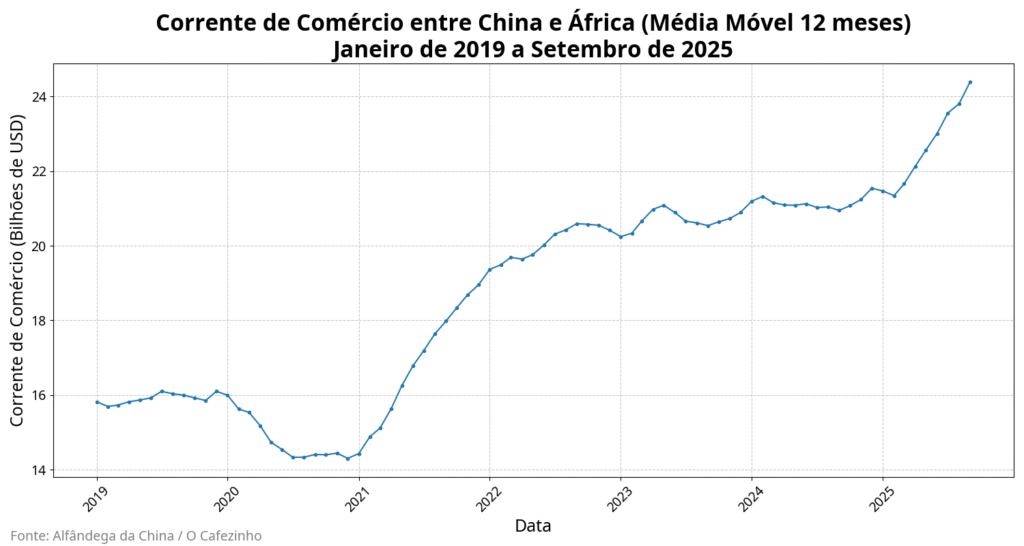
Europe has an alternative path. It must re-establish diplomatic and commercial relations with Russia, increase its relations with China and with Asia in general, and establish a more intelligent and less colonial relationship with Africa, joining China in efforts to build better infrastructure there and develop the economies of African countries so that the continent becomes a more sophisticated market for European products and services. Only through this geopolitical and commercial reorientation can Europe recover its autonomy, its prosperity, and its future.
This false narrative is just a way to deceive the population into accepting social cuts and rising inequality on the continent.
Meanwhile, China demonstrates how it is worthwhile to invest in diplomacy instead of wars. If the United States and Europe had applied the trillions of dollars spent on imperial wars in recent decades to infrastructure, such as a high-speed rail network, their companies would enjoy greater productivity and be much better equipped to engage in healthy and peaceful competition with China.