
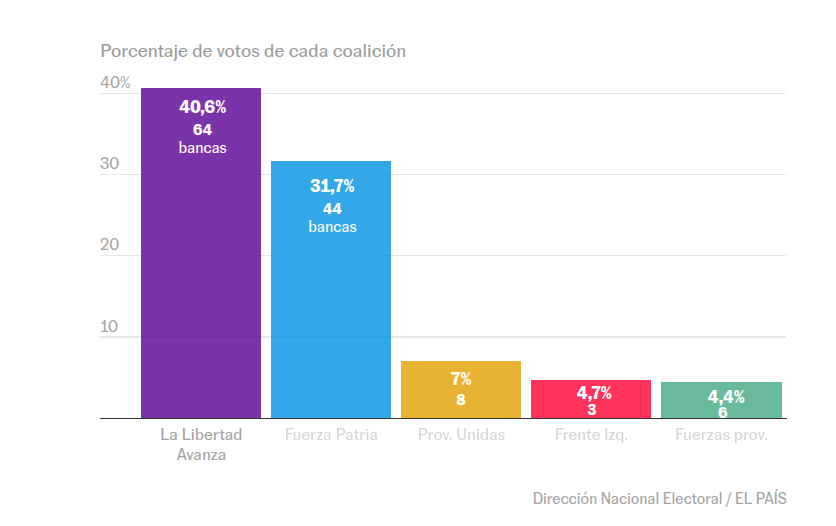
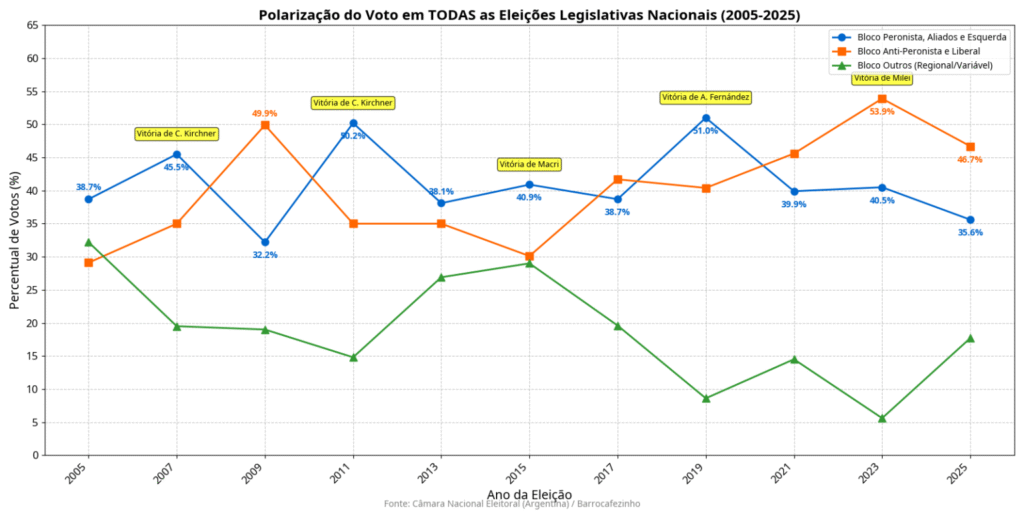
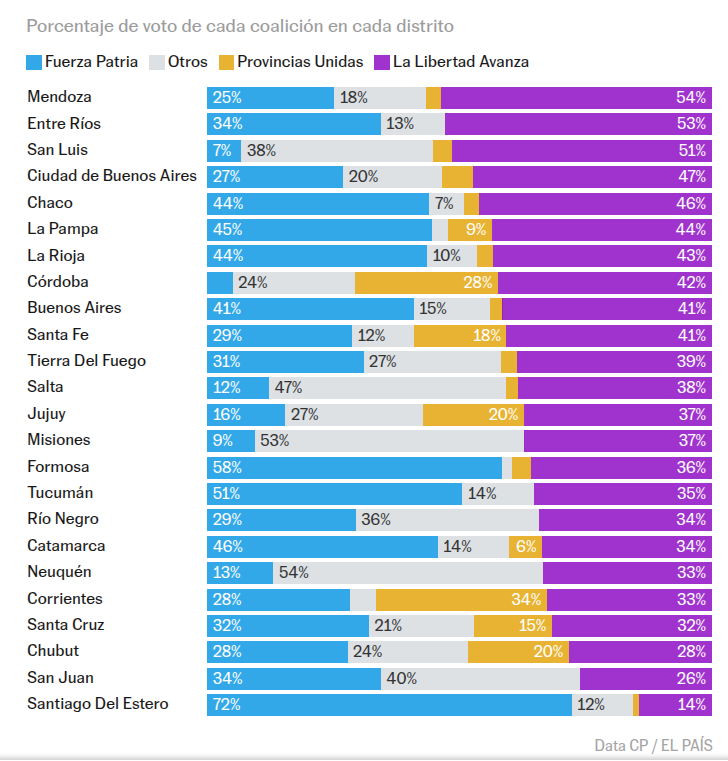
The official result of the legislative elections on October 26, 2025, confirmed the advance of Argentine President Javier Milei and his party, La Libertad Avanza (LLA), which won with 40.6% of the vote. Peronism (Fuerza Patria) obtained 31.6% of the votes.
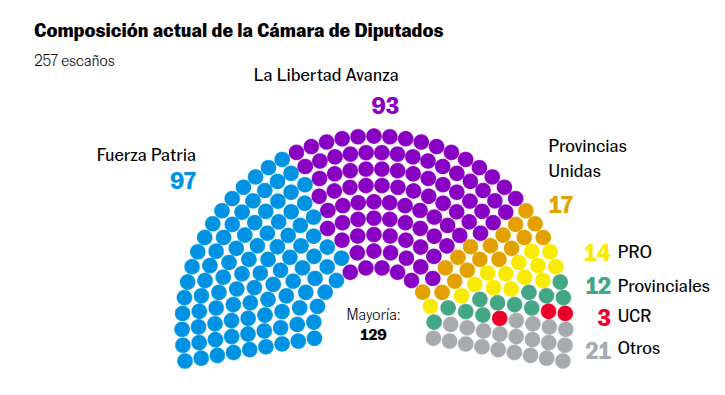
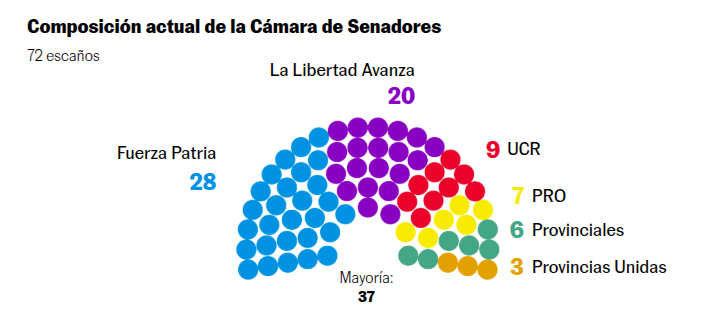
However, Peronism resisted. The main Peronist bloc (Fuerza Patria) maintained the largest bench in the Chamber of Deputies (97 seats) and in the Senate (28 seats), in contrast to the 93 deputies and 20 senators of Milei’s party (La Libertad Avanza).
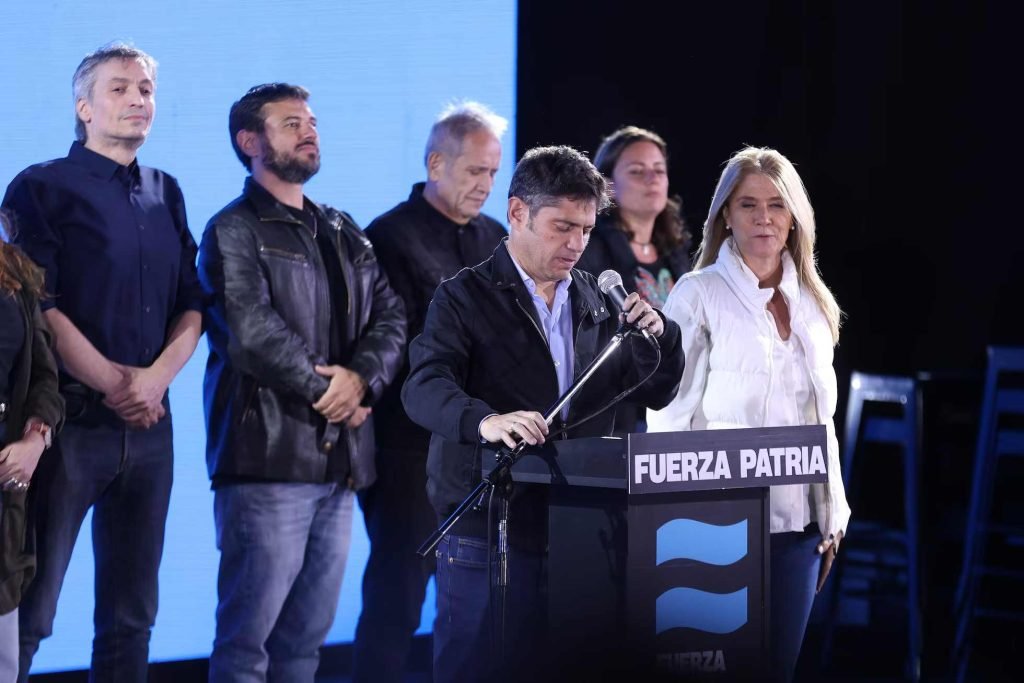
A few months earlier, on September 7, 2025, Peronism had achieved an expressive victory in the provincial legislative elections of Buenos Aires. The candidates linked to the governor of Buenos Aires, the Peronist Axel Kicillof, obtained 47.28% of the votes, against 33.8% for Milei’s party. The disappointing result for Milei’s party in the province (which concentrates about two-fifths of the national electorate) was considered a harbinger of its defeat in the national legislative elections. The Peronist victory, in turn, reinforced Kicillof’s position as the main opposition leader.
The Peronist victory in those provincial elections makes us ask: what happened since then for the national scenario to change so expressively?
In this Sunday’s elections, this time not for the Provincial Legislature, but for the National one, the Peronists had about 41% of the votes in Buenos Aires, the same percentage as Milei’s party.
The most important answer is Donald Trump’s blackmail. Milei’s triumph in the legislative elections happened after a disconcerting episode of international interference.
On October 14, 2025, during a public meeting in the Oval Office of the White House with the Argentine president, Donald Trump made a direct threat: if La Libertad Avanza did not win the legislative elections, the United States would not be “generous” with the country.
This was embarrassing coercion, as it tied the crucial loan for the country to an electoral result favorable to the government.
This action was accompanied by the nod of a loan and financial support package that, added to other agreements, approached the impressive figure of US$ 64 billion. That is, to get an idea of the importance of such an amount for Argentina, this sum corresponds to almost 70% of the total cost of the Argentine federal government in the year 2025.
The loan and financial support package includes: US$ 20 billion from the IMF (Preliminary agreement approved in April 2025), US$ 40 billion from the United States (Total package that includes a formalized financing line of US$ 20 billion and a second support of US$ 20 billion under negotiation), and US$ 4 billion from the World Bank (New loan announced), totaling US$ 64 billion in consolidated value of new loans and high-value negotiations in 2025.
Faced with such a dramatically vulnerable economy, with Argentina’s external debt reaching a record US$ 305.043 billion in September 2025, this pressure from Trump became a checkmate.
Argentina’s economic fragility is immense. The country has a marked dependence on speculative capital from the US. Furthermore, the Argentine exchange system is tied to loans from the IMF, which is controlled by Washington. This combination created a scenario of total exposure.
The very movement of the markets after Milei’s triumph made the risk clear: if Peronism had won, there would have been massive capital flight and a resounding crash in the Argentine stock markets, leading to a financial crisis. This insecurity pushed the entire economic and productive sector to support Milei, or, at the very least, to withdraw any support for Peronism.
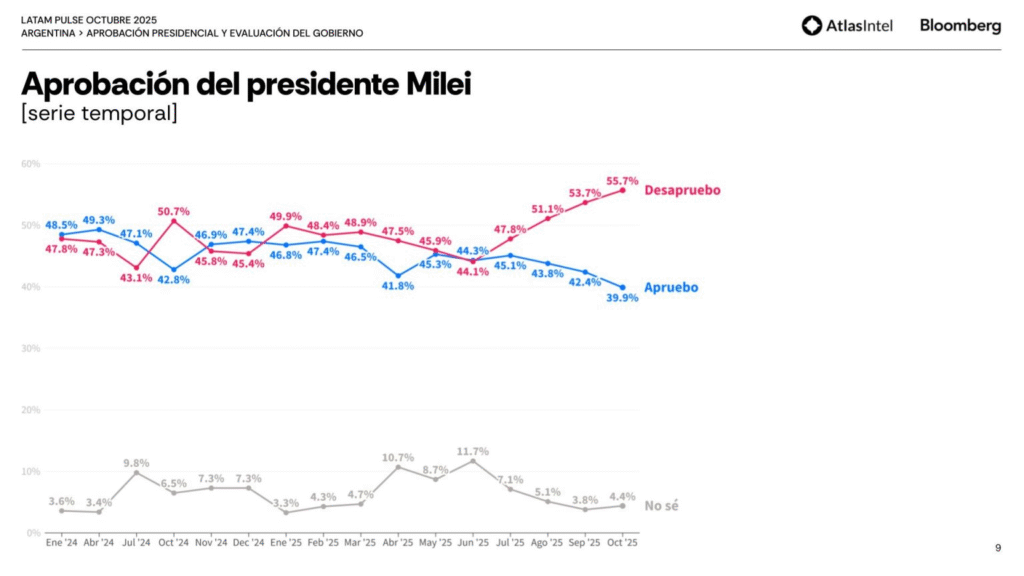
The LLA’s performance was classified as “unexpected” by the international press, as the most recent polls indicated that Milei’s popularity was in decline and that the scenario would be “tight.”
The result in the province of Buenos Aires, where Peronism had won by a wide margin weeks before, was a tough and unexpected blow for Peronism. However, Milei’s approval, according to the latest Atlas Intel (October/2025), was at 40%, in line with the votes received. This suggests that the result could have been much worse for Peronism if Milei’s popularity had not fallen so sharply in recent months.
It is a recurring fact that the populist far-right, for some methodological or under-representation reason, frequently stays off the radar of traditional polls and advances at the ballot box. The Argentine result reinforces this trend, showing that support for Milei was deeper than the opinion surveys could capture.
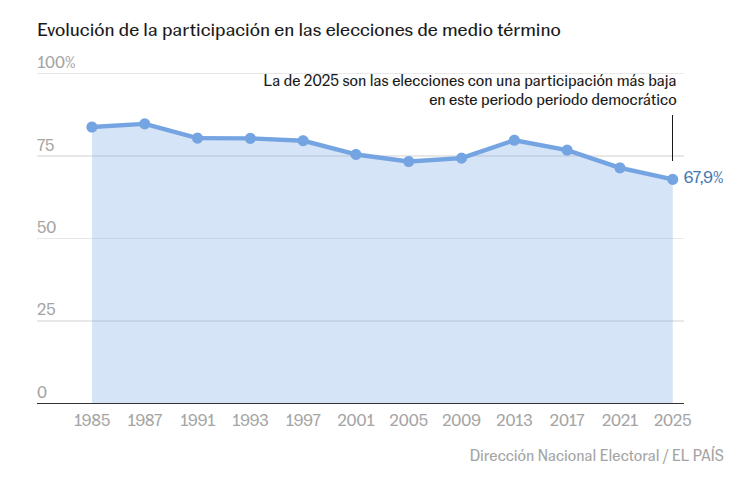
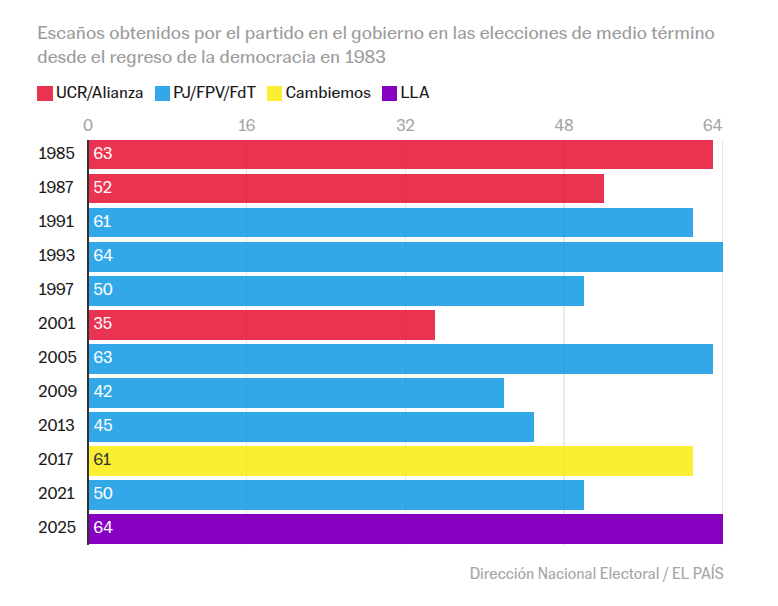
Although Milei’s performance is not unprecedented for a mid-term government, the vote took place in the context of a scandal that tainted the main LLA candidate, José Luis Espert, who resigned due to an investigation linked to drug trafficking, but whose name remained on the ballots. Furthermore, the election registered the lowest turnout (68%) since the return of democracy.
Despite the defeat, Peronism (Fuerza Patria) is still alive. By joining other left-wing and opposition blocs, the Argentine situation shows that Peronism is still a national, competitive force, capable of organizing resistance to Javier Milei and returning to power in the next national elections.
The economic crisis is structural and can only be solved through a major national project tied to a repositioning of Argentina in the world. For this, it will need to break with the excessive dependence on the United States and promote alliances with other important geopolitical actors, such as China, Brazil, ASEAN, and others.
Milei’s strategy of lowering inflation through the “violent asphyxiation of internal consumption” is seen by many analysts as unsustainable.
The cultural and ideological war in Argentina is still open. The future of the country and of Peronism will depend on the popular struggle. The next chapters will be written by the streets.
Notes for International Readers:
- Javier Milei: The libertarian, far-right President of Argentina, known for his radical economic “shock therapy.”
- La Libertad Avanza (LLA): “Liberty Advances,” Milei’s political party.
- Peronism (Fuerza Patria): Peronism is a broad, complex, and dominant political movement in Argentina, founded by Juan Perón. It traditionally includes left-wing, nationalist, and labor-focused factions. “Fuerza Patria” (Fatherland Force) is the name of the main Peronist opposition bloc mentioned in the article.
- Axel Kicillof: A prominent left-wing Peronist figure and the governor of the powerful Buenos Aires province, seen as a main opposition leader to Milei.
- IMF (International Monetary Fund): Referred to in the original text as FMI (Fundo Monetário Internacional). Argentina has a long and deeply troubled history with the IMF, to which it owes tens of billions of dollars, giving the fund significant leverage over a-ss policy.