
Don’t be too quick to buy into the Western media narrative.
What’s unfolding in Iran represents yet another regime-change operation employing the most underhanded and criminal tactics imaginable.
This past Monday, January 12th, millions of Iranians took to the streets of Tehran and at least thirteen cities nationwide to defend their constitution, national sovereignty, and reject terrorism and violence as tools of political action.
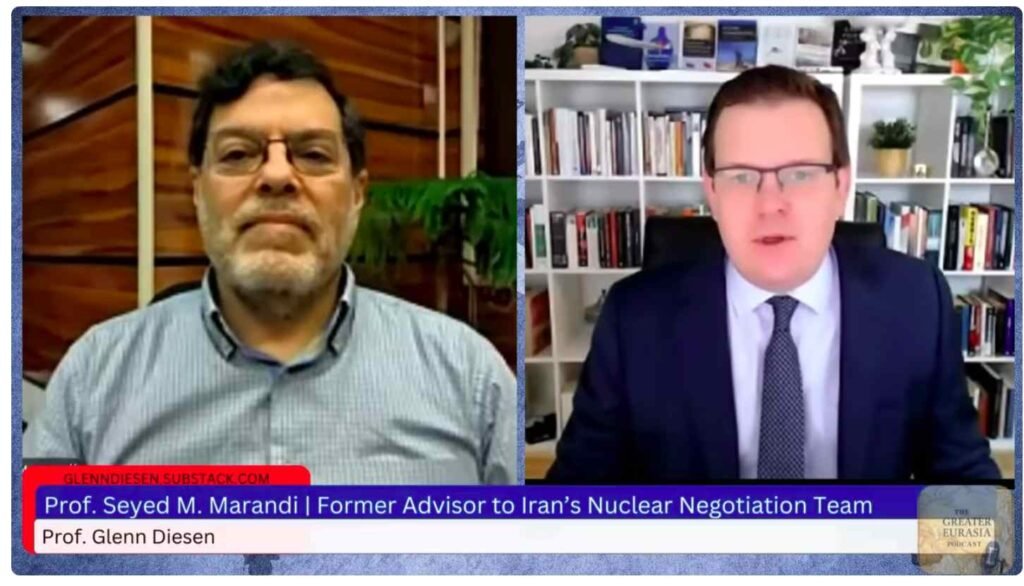
According to Professor Seyed Mohammad Marandi of the University of Tehran and former advisor to Iran’s nuclear negotiating team, speaking on Professor Glenn Diesen’s “The Greater Eurasia” podcast, it was likely the largest gathering the country has ever witnessed, with well over a million people in the capital alone. The professor emphasizes that these crowds weren’t merely government supporters, but citizens across the political spectrum united in defense of state legitimacy against foreign interference.
In a city plagued by Tehran’s notorious transport challenges, the effort required for people to reach the streets speaks volumes about the depth of national sentiment. The destabilization campaign followed a familiar playbook: a speculative assault on Iran’s currency, orchestrated with backing from Israel and the United States.
The West has been attempting this for years, but this time managed to tank the currency by an estimated 30% to 50% in a remarkably short span.
Marandi maintains the crash was engineered from abroad, with the United States and Western allies applying pressure on Iranian currency exchange platforms.
Economic destabilization always serves as the opening salvo in regime-change operations. The protests began in Tehran and other cities with several thousand participants, mostly small business owners and shopkeepers facing bankruptcy amid the currency turmoil.
On day one, demonstrations remained peaceful, with no police intervention or arrests.
By day two, everything had changed.
Small, highly disciplined and organized groups began infiltrating the protests and instigating extreme violence. Marandi reports that over one hundred law enforcement officers were killed within days, some decapitated, burned alive, or having their faces and skulls crushed.
Among the victims were a nurse who died when a clinic was torched and a member of the Red Crescent. Local physicians reported many shot with handguns and pistols at close range from within the crowd itself.
The tactics echo the Maidan playbook in Ukraine, where a 2014 coup was staged against the elected president.
That operation, orchestrated by U.S. intelligence services, installed an American puppet government in a calculated strike against Russia that ultimately sparked war.
The goal was to provoke Russia and sow regional instability. In Maidan, snipers fired on both police and civilians to inflate casualty counts and pin blame on the government.
The destruction of public property proved massive: public buses, ambulances, fire trucks, banks, and private homes went up in flames.
The organizations driving this violent escalation included ISIS, the Mujahedin-e-Khalq (a terrorist outfit based in Europe), monarchists, and Komoleh, a Kurdish terrorist group.
The Iranian government’s decision to shut down internet access was justified as necessary to disrupt coordination among these violent factions. Once connectivity was severed, the violent protest network suddenly collapsed, no longer able to coordinate with foreign bankrollers.
Marandi describes a sprawling Persian-language media empire bankrolled by the West to the tune of billions, encompassing TV channels, bot armies, and Telegram channels dedicated to psychological warfare against Iran.
This is profoundly asymmetric warfare.
On one side, the West deploys dozens, hundreds, even thousands of websites and social media accounts, all funded with virtually unlimited resources to destabilize the Iranian regime. On the other, a nation that has withstood decades of sanctions and imperial pressure yet faces mounting challenges in penetrating the information blockade imposed by Western mainstream media.
Figures like Mike Pompeo and agencies like Mossad made no secret of their involvement, posting messages indicating agents on Iranian soil.
Voice of America, the U.S. government’s propaganda arm, likewise published messages inciting violence against Iran’s government.
Former President Donald Trump went so far as to claim, incorrectly, that a major Iranian city had fallen to “freedom fighters.” Marandi categorically refuted this: not a single city, not even a village, was taken by anyone.
In the professor’s assessment, Trump remains woefully ignorant of basic facts, and policies built on such faulty intelligence are destined to fail.
Marandi’s analysis extends beyond Iran’s immediate crisis.
He argues the endgame for the United States and its allies aligns with what the Israeli regime desires: a fragmented Western Asia and North Africa, with nation-states torn apart. In his view, given the chance, the Israeli government would do to Saudi Arabia, Egypt, and Turkey what it did to Syria.
The professor sharply criticizes regional leaders like Erdogan, who collaborated in Syria’s destruction under Obama-era policies, believing he could forge a mini-Ottoman Empire. Erdogan failed to anticipate that his Washington allies would invariably choose Israel over Turkey.
The pattern keeps repeating.
First, destabilize society through sanctions and information warfare.
Then exploit legitimate public grievances to trigger violent protests. International rhetoric reduces everything to a binary choice: either you support “brave protesters” or you’re complicit with “dictatorship.”
Historically, from the Arab Spring onward, such interventions haven’t delivered liberation but destruction, as foreign powers pursue zero-sum geopolitical interests.
Marandi reiterates that Iran’s government enjoys popular support and that Western predictions of imminent regime collapse amount to wishful thinking, recycled every few years like clockwork.
He encourages international observers to examine footage of the pro-constitution rallies and judge for themselves whether demonstrations of that scale happen in their own countries. The answer will reveal much about where genuine popular legitimacy truly resides.