
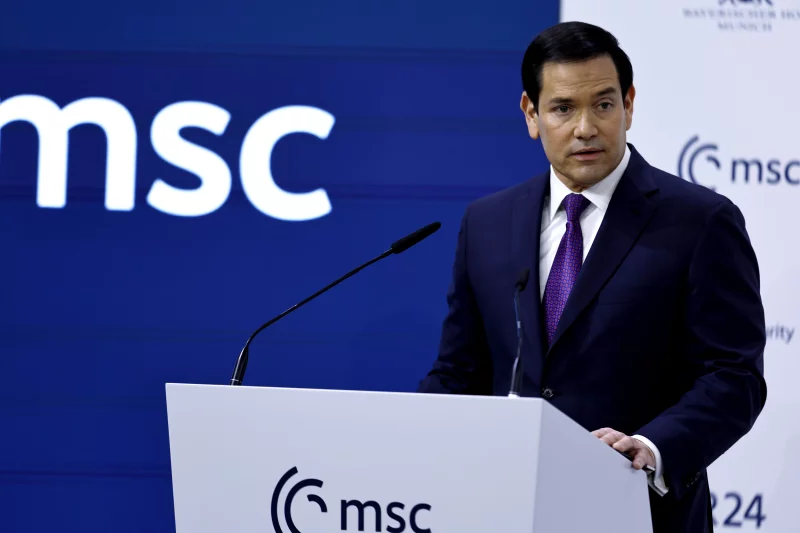
Marco Rubio in Munich
The new “democratic fascism” of American imperialism
Never before has there been so much talk about democracy.
In the name of grand democratic ideals, they bomb hospitals, kill journalists, and mutilate children.
In the name of democracy, they kidnap presidents of sovereign nations.
In the name of democracy, they block access to fuel for entire populations, with the explicit, declared objective of generating a humanitarian crisis.
In the name of democracy, the democratic elites of the world’s most democratic nations are willing to start devastating wars, promote genocide, prohibit free maritime trade, and destroy countries through increasingly brutal sanctions.
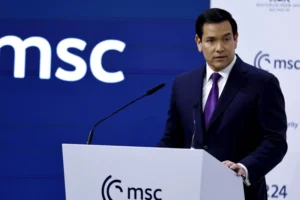
In the name of democracy, Marco Rubio delivered a grim speech at the Munich Security Conference on February 14, 2026, attacking any initiative to seek a more… democratic international order.
Before an audience of cowardly and complicit leaders, Donald Trump’s pitbull explained that democracy would belong exclusively to the armed champions of Western civilization.
Let’s go back a few weeks, though.
In the early hours of January 3, 2026, with authorization from the President of the United States, Donald Trump, Operation Absolute Resolution entered Caracas with more than 150 aircraft and about 200 special operations troops, captured President Nicolás Maduro and Cilia Flores, and removed them from the country—taking them to a detention center in New York.
The numbers circulating in the following hours pointed to around 100 Venezuelan and Cuban deaths, with no Americans killed.
After a few hours of stunned silence, international reactions began to appear.
The democratic leaders of the democratic world were the first to speak out.
The President of France celebrated the end of the dictatorship in Venezuela, implicitly suggesting that he considered the American operation to be yet another brilliant imperial contribution to the spread of democratic values in the world.
Later, embarrassed by the negative repercussions of his remarks at home—since even the far-right leader Marine Le Pen had harshly criticized such a brutal violation of international law—Macron adopted the most openly cynical and hypocritical line that characterized the European responses.
British Prime Minister Keir Starmer said he would not “shed tears over the end of the Maduro regime,” but noted, timidly, almost with shame, that everyone should respect international law.
German Chancellor Friedrich Merz echoed this sentiment, criticizing Maduro for “leading the country to ruin and rigging elections,” while acknowledging that a “legal assessment of the American intervention is complex and requires careful consideration,” as international law “remains the frame of reference.”
Kaja Kallas, the European Union’s foreign policy chief, reiterated that Maduro “lacked democratic legitimacy,” called for “calm and restraint,” and advocated for a negotiated solution—thereby similarly weakening her own comment (I wouldn’t even call it criticism, it was so discreet) about the need to respect international law and the Charter of the United Nations.
In the deliberately intricate semantic game of diplomatic language, democratic leaders in the Global North made it clear that they were willing to give a moral stamp of approval (whether out of fear, cowardice, or self-interest, it doesn’t matter) to the criminal kidnapping of a head of state of a sovereign country.
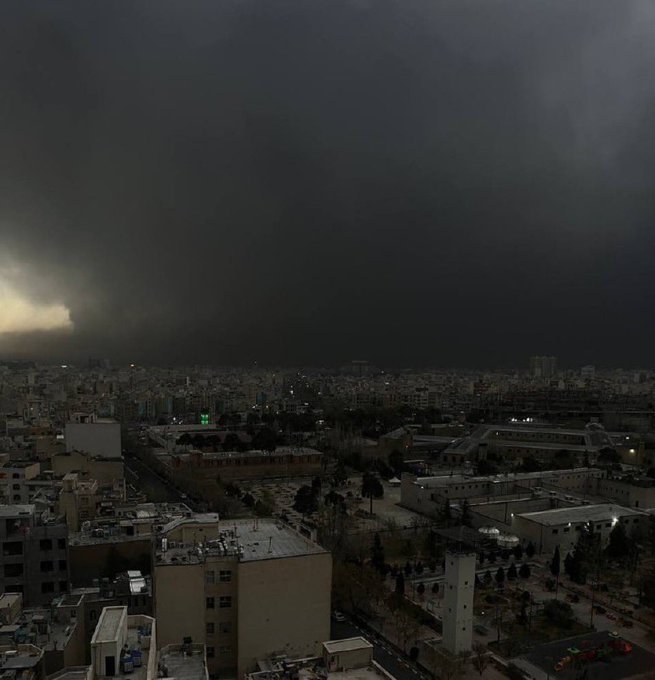
The fact that Venezuela never attacked the United States, that the motives for the kidnapping were based on blatantly false accusations, that a bloodbath was perpetrated against the president’s security team, that civilians died and were injured, that electricity was knocked out in parts of Caracas—none of this seems to have moved the democratic leaders of Europe.
These same democratic Pharisees also seem to have failed to consider that Venezuela’s economic problems stem primarily from economic sanctions, not from a lack of democracy.
The reaction from leaders in the Global South was quite different.
President Lula called the operation a “very serious affront to the sovereignty of Venezuela” and warned that attacking countries in violation of international law is “the first step toward a world of violence, chaos and instability, where the law of the strongest prevails over multilateralism.”
Brazil joined Mexico, Chile, Colombia, Uruguay, and Spain in signing a joint declaration rejecting the operation.
Mexican President Claudia Sheinbaum stated that the operation violated the UN Charter and that the United States should “end all acts of aggression against the Venezuelan government and people.”
China expressed “deep shock” and strongly condemned what it called “hegemonic acts” that “gravely violate international law and the sovereignty of Venezuela.”
Russia classified the operation as an “act of armed aggression,” demanding the immediate release of Maduro and his wife.
The beginning of 2026 therefore witnessed the curious case in which the leaders of the Global South, who are generally not included in the select club of democratic nations, were the only ones who truly demonstrated genuine outrage against the violent and anti-democratic tyranny of the United States.
If the operation in Caracas was the act, Rubio’s speech in Munich, six weeks later, was the doctrine. The great fascist manifesto of the 21st century. A democratic fascism, naturally.
It also serves to anchor our thesis: that democratic doctrine needs to be re-examined very carefully by global citizens. It is a task too important and complex to be left solely in the hands of political scientists or philosophers (who, obviously, are welcome and necessary to the debate).
Based on the statements from the various global leaders we have cited, I suspect that the mission to emancipate the democratic concept from the imperial prison in which it finds itself—guarded by a media and academic army that, in recent decades, has become increasingly subservient to the power of force and violence—has a greater chance of succeeding in the political periphery of the world.
In his speech, Rubio praised five centuries of European expansion and presented the post-World War II retreat as a “wrong choice.” The end of empires, however, was not a voluntary act, but rather the dramatic outcome of decades of revolutions and anti-colonial struggles.
One of the most disturbing aspects of his speech, therefore, is that the wars, the fascist movements, the genocides—the diabolical wave of violence and death that culminated in World War II—were born precisely from this cynical and opportunistic cult of Western civilization that we see in Marco Rubio, throughout the Trump administration, and in its minions in other countries.
Rubio called the limits imposed by international law mere abstractions, attacked the UN as useless, and portrayed unilateral actions as proof of efficiency—because, he says, it would make no sense for there to be any restrictions on the new imperial impulses of Western civilization.
But what exactly is this Western civilization?
Were the Laws of the Twelve Tables a victory for the Roman plebeians after centuries of popular struggles?
Were they the struggles of Roman slaves for freedom?
Were they the intellectual wars of the Renaissance against the darkness of the conservative obscurantism of the Catholic Church and the medieval order?
Could it be the French Revolution?
The liberal revolutions (some with strong socialist undertones) of 1830 and 1848?
Could this be the invention of socialism, or social democracy, of public social security for all, of universal and free public education systems?
No, obviously not. Marco Rubio’s Western civilization corresponds only to the military expansion of the European empires—achieved at the cost of millions of deaths and enslavement in Africa and Asia, the excessive accumulation of wealth, and bloody violence against countries and peoples made vulnerable because they had not yet mastered modern technologies of war.
Western decline, ironically, unfolded when large and small European nations organized political systems that guaranteed, for the first time in their history, food security, labor rights, state-run transportation infrastructure, and an equitable distribution of income for their populations.
Contrary to Rubio’s fascist preaching, therefore, the peak of Western civilization is not the moment of imperial expansion, when the European and American working masses lived in misery, but precisely the post-war period, marked by great social achievements. This period of brilliant advances for the well-being of Western workers is seen, however, by the far-right currents represented by Rubio, as a “decline.”
It is curious, moreover, that Rubio has such an exclusivist view of what Western civilization is, associating it only with the white race and Christian religions.
He seems to forget that, at least geographically, Africa and Latin America are also located in the West. Rubio is possibly referring to what some call the “collective West,” made up of a handful of nations militarily allied with the United States.
Even so, it is obviously a grotesque error, typical of a prejudiced fascist like Rubio, to ignore the African and Asian contribution to the great achievements of Western civilization.
Ancient Judea, or Palestine, where Christ lived and was born, was a region considered for many centuries to be located in the East, with a history marked by the influence of the peoples who lived in Mesopotamia (where Iraq is today), Egypt, and Anatolia (today Turkey), all in Asia.
Islamic culture, which produced so much science, founded the first universities in the Mediterranean, and protected thousands of ancient classics in its great libraries, including those of Greece and Rome, did it not also contribute to our Western civilization?
China—whose public-service ethic Leibniz and Hegel so praised, and which invented gunpowder and the printing press—offered nothing to Western civilization?
Rubio’s speech revives — surprisingly — an arrogant tradition from the late Middle Ages, consolidated after the Enlightenment with texts by Arnold J. Toynbee, Spengler, and Hegel, treating “Western civilization” as a kind of separate cultural bloc in the world.
In 2026, it is just another ridiculous imperial fantasy of the current White House—one that grows more and more delusional as the global economy shifts to other parts of the world.
But ultimately, who benefits from reviving this idiotic pride in “Western civilization” when we can be happy, modern, prosperous, and secure by adopting an open and universal geopolitical philosophy that includes the entire planet and all civilizations?
Does Western civilization have values that are irreconcilable with the rest of the world?
In fact, Rubio’s schizophrenic megalomania, in defense of a white, Christian, reactionary Western civilization—a kind of “MAGA” applied only to the new Rome and its obedient subjects—is based on a nostalgia for a world that no longer exists.
In the 19th century, at the height of Western imperialism, Europe accounted for more than 20% of the world’s population. Today, it accounts for less than 9%.
On the other hand, 19th-century Europe was a continent marked by profound inequalities, dirty cities, and precarious urban infrastructure. It is impossible to compare the quality of life of the average European today with what it was around 1850. But Rubio seems unconcerned with quality of life, especially since the essence of his discourse is a visceral hostility to any feeling of human empathy.
At one point in his speech, he speaks scornfully of efforts to create a global social welfare system. Hatred of the poor—always seen as responsible for their poverty—is the strongest sentiment of the far right. The neo-imperial project of Trump and Rubio, and of all their followers worldwide, therefore translates almost into a global war on the poor. That is what explains the morbid pleasure—the sadistic euphoria—they display in the face of the genocide in Palestine, the economic strangulation of Cuba, and the humiliating blockade on Venezuela’s ability to sell its oil to whomever it wants.
The fear that the same collective West feels toward China, and the efforts to contain the technological advances of the Asian giant, are also explained by this contempt for the humiliated and oppressed of the earth. After all, as the Vice President of the United States, J.D. Vance, himself let slip, how can Chinese peasants challenge American hegemony in the world?
It’s difficult to understand what kind of Christian heritage these extremists are talking about, when the great moral revolution brought about by Christ was precisely the preaching of love for those who suffer injustice, for the poor, for the disadvantaged.
The central theme of our campaign, however, is to break the shackles that keep democracy chained in the theoretical prison built by fascist neo-imperialism.
How is it possible that such a beautiful concept is so brutally manipulated to advance a culture of authoritarianism, intolerance, and violence—the exact opposite of what we should understand as democracy?
The United States wants to use democracy, therefore, to justify a global military dictatorship—led exclusively by the United States, with some vassals from the Global North as its viceroys.
Democracy, however, in its most basic sense, is the rule of law and justice.
Domestically, this means that no one is above the law and that power must be limited by checks and balances.
On the international stage, this means that no country should place itself above international law and multilateral institutions, because without this common ground the world regresses to a state of savagery.
One could argue that there is no real system of international law, since no institution has yet been created with the power to impose it on countries.
However, I don’t accept the argument because it’s simply cynical.
We have the United Nations, with its treaties, agreements, and laws, which simply need to be respected. The UN itself possesses certain powers, which need to be democratically discussed and expanded, to impose restrictions on countries that violate international law and treaties.
Although the UN is currently in a particularly vulnerable and ineffective phase, it is not up to the international community to reinvent the wheel, but to work to strengthen existing multilateral institutions, because this is the only way to combat widespread anarchy and the risks it poses to stability and peace in the world.
There is another extremely symbolic point in Rubio’s speech:
“(…) We do not want our allies to be weak, for that weakens us. We want allies who can defend themselves, so that no adversary will ever feel tempted to test our collective strength. That is why we do not want our allies to be shackled by guilt and shame. We want allies who are proud of their culture and their heritage, who understand that we are heirs to the same great and noble civilization and who, together with us, are willing and able to defend it.”
This seems to me to be the moral core of Marco Rubio’s “democratic fascism.” The vassals must abandon their scruples and blindly obey imperial directives, without counterpoint, without reflection.
This is, in fact, the same thing Donald Trump himself said in an interview with the New York Times, also in January 2026: that international law means nothing to him, and that the only limit to his actions would be his own morality. Which means there is no limit.
For the empire’s own citizens—and that is why Europeans should not submit so docilely to this macabre philosophy—the White House’s push for forceful solutions also constitutes a growing danger to their security, freedoms, and rights.
The fate of Renee Good and Alex Pretti, American citizens shot dead in January 2026 by federal agents serving the fascist agenda of the American far-right, showed that the new ethics of the empire is violence without limits. In a way, it always has been—the novelty now is that the new American right flaunts it as a badge of strength, and derides as weakness (a source of “guilt and shame”) the previous attempts to disguise or hide it with lies.
However, humanity has no alternative but to fight, in every possible way, the new imperial fascism that threatens its survival. Not all is lost. The empire’s brutal reaction is proportional to the advance of the rest of the world: the more the balance is restored, the more violent becomes the resistance of those who lose the monopoly on force. In the 19th century, the concentration of power, capital, and technology in that handful of countries that Rubio today calls “Western civilization” was overwhelming. Not today. The world today has a far more distributed economic production, which is, incidentally, why Rubio was whining in Munich about decline and deindustrialization.
The fight against imperial fascism is the same fight for the expansion of multilateralism, for the strengthening of international law, and for the consolidation of a culture of mutual respect among nations. This is what all the major leaders of the Global South have been preaching in unison.
The economic and military power of the Global South will be the most effective instruments to push back imperial fascism. In a way, this is already happening, which is why the world is watching the spectacle of violence promoted by the United States with such stupefaction, almost disbelief. Many global leaders remain silent in the face of Trump’s barbarity, understanding that they are facing an armed and irrational power. At the same time, never in the history of the world have we seen such a frenetic international movement (sometimes discreet, sometimes not) by these same leaders to close commercial and political agreements with a vast range of countries, even if it means isolating the United States.
But there is another important front in this whole struggle for justice, equity, and peace in the world, which is to exploit one of the most vulnerable points in the strategy of domination used by the West: the absolutely central role that its societies give to the democratic concept.
Or rather: the importance they place on control and manipulation over what the world should understand as democracy.
What happens, however, when democracy becomes an imperial weapon used to impose, through violence, an essentially anti-democratic global regime, in which decisions affecting all of humanity are made by a plutocratic elite deeply hostile to everything that democracy truly represents?
The result is the creation of an ever-widening flank in the ideological walls that the West has built around its culture. This breach must be exploited by democratic discussion itself, by ideological and philosophical debate, about what the classic concepts of freedom, dignity, sovereignty, and equality mean for humanity, and all that arsenal of values that, together, forge democratic doctrines.
To reclaim the concept of democracy, however, we need to return to its origins, freeing it from a history that has always been invented with the aim of keeping it captive to Western imperialism.
My email: [migueldorosario@gmail.com](mailto:migueldorosario@gmail.com)
Follow me on X: ocafezinho
Follow me on Instagram: ocafezinhooficial